
Editor’s Note: This story originally appeared in Volume IV of B.H. Magazine. To get your copy (and access to future issues), subscribe here.
Whether by serendipity or design, amidst its cultural impact as a humble $9.6 million picture and artificial intelligence-related controversy, The Brutalist has become emblematic of modern cinema. In more ways than one.
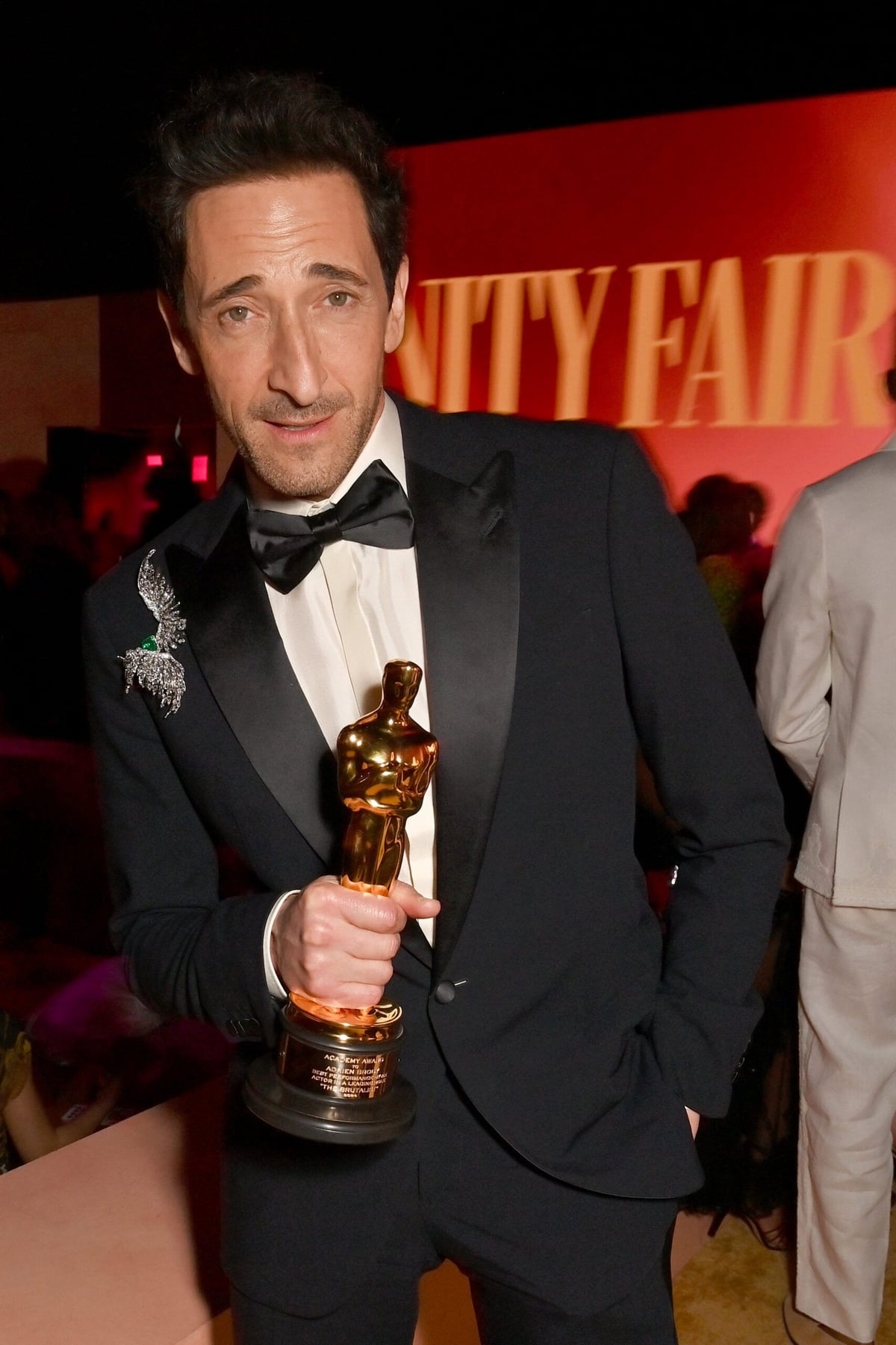
“Really, what it speaks to – at least for me – is how much is lost creatively in this world. And so it was even more meaningful to tell the story about the great potential that has been extinguished,” says two-time Academy Award winner, Adrien Brody, in conversation with B.H. Magazine.
For one, despite the remarkable storytelling it achieved with shoestring spend – bolstered by masterful acting and an equally masterful screenplay – director Brady Corbet’s sprawling three-and-a-half-hour period drama faced backlash early in its award season campaign for leveraging AI.
Aside from generating a handful of architectural schematics to stretch what few dollars were on hand, the new-age tool was used to correct certain vowels in Brody and co-star Felicity Jones’ Hungarian dialogue (a notoriously challenging language for native English speakers) – bringing their otherwise flawless and emotionally nuanced performances into scrutiny.
It’s worth noting that identical software was used for fellow Oscar contender Emilia Pérez.
Instead of celebrating efficiencies in production, this revelation threatened what had essentially been an assured second statuette for the film’s male lead. Thankfully, the merit of Adrien Brody’s career-defining portrayal overpowered the chorus of online commentary.
He secured that coveted sophomore Best Actor honour, defending his decades-long title of youngest Best Actor winner at the 97th Academy Awards against Timothée Chalamet (A Complete Unknown) in the process; the latter of whom Hollywood was ready to anoint this generation’s DiCaprio based on the momentum of an impressively charismatic campaign.
“I'm incredibly honoured and humbled by receiving recognition for work that's meaningful to me,” Brody says when asked about his latest Golden Globe victory.
“I think it's been many, many years since I’ve found a character with this much complexity and a filmmaker that has entrusted me with a role of this magnitude.”
RELATED: The Truth About The Oscars
Secondly, The Brutalist follows Bauhaus-trained architect and Holocaust survivor László Tóth (Brody), whose trials and tribulations don’t end at the barbed-wire gates of the Buchenwald concentration camp.
The talented Hungarian-Jewish immigrant soon finds himself in the socio-political furnace of post-war America, where he fights to preserve his artistic vision for an ambitious community centre while grappling with heroin addiction, vile industrialist and client Harrison Lee Van Buren (Guy Pearce), as well as the relentless machinery of capitalism.
“The hopes and dreams of immigrants and the disconnect between it and the reality and hardships of the American Dream. It does speak to greed and certain oppressive forces within the system. I think this film also speaks to the artist's journey,” explains Brody.
“It’s steeped in reality. More films should honour reality and enable their protagonists to represent the flaws and frailty of life around us.”
At a time when seemingly every working actor has picked a side in Marvel/DC’s ongoing CGI-driven war – or inked multi-picture deals to produce low-stakes streaming fodder in an informal throwback to the Golden Age of Hollywood’s studio system – much like his fictional counterpart, Adrien Brody has exercised a well-disciplined “no” whenever it mattered.
His recent filmography will tell you everything you need to know about his largely uncompromising approach to the craft. “Largely,” given we understand he probably needed to pay the bills with the likes of Ghosted and Fool’s Paradise.
In the last half-decade, Brody’s most memorable turns have ranged from a two-episode stint as billionaire Josh Aaronson on HBO’s Succession, and the legendary Pat Riley in HBO’s short-lived Winning Time: The Rise of the Lakers Dynasty; to the obligatory appearances in longtime collaborator Wes Anderson’s The French Dispatch and Asteroid City.
“There have clearly been parallels in my career, but I'm very grateful to have even had the privilege of being a working actor – even before I received recognition years ago,” he says of his first Oscar victory for The Pianist in 2003 (incidentally as another artistic Holocaust survivor in Władysław Szpilman).
“People thought I was an overnight success after I'd been acting for 17 years,” adds Adrien Brody. “It's been a long journey.”
If you’ve enjoyed this interview with Adrien Brody, consider a few more of our favourite stories – direct from the pages of B.H. Magazine:
- Derek Guy Has Entered The Chat
- Pumped Up & Dangerous: The Hidden Epidemic Of Steroid Abuse
- Canvass The Opportunity: Your Guide To Investing In Australian Art
- The True Cost Of Luxury: Confessions Of A Restaurant Critic
- The Empire Steps Back: Western Diplomacy In The Trump Era
Also read: