

This story originally appeared in Volume 6 of B.H. Magazine, pre-order your copy of Volume 7 now.
Gripping a steering wheel to find it sopping wet – like a Pat Rafter sweatband after five brutal sets – isn’t something I’ve encountered before. But the journo who’s just climbed out of the Ferrari F80 is dripping from every pore… and honestly, it’s possible he was crying too.
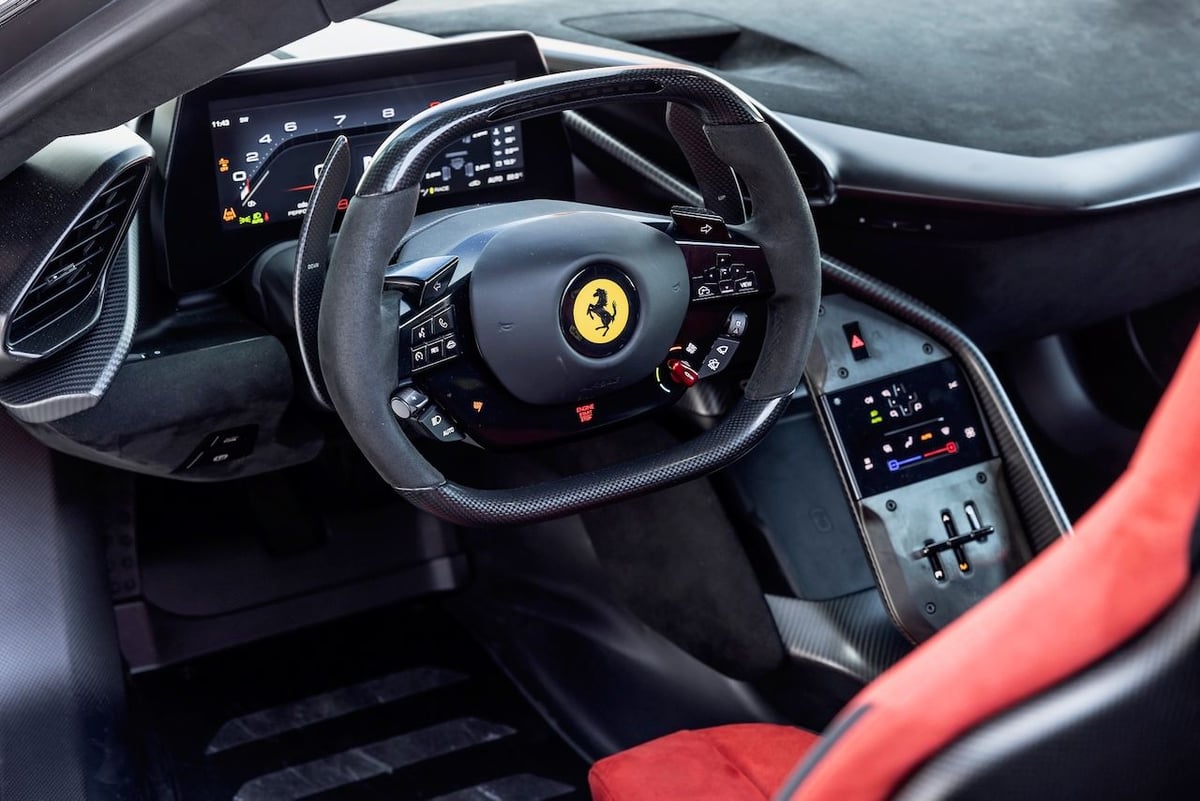
The steering wheel on this ridiculous, beyond bonkers hypercar is a thing of squared-circle beauty, laden in now sodden Alcantara. It offers barely more than one full turn, lock-to-lock. That’s by design. Because in the fastest Ferrari the world has ever seen, you don’t have time to cross your arms – or even adjust your hands – mid-corner.
I could totally sympathise with my colleague’s fear-sweating hands. I have only felt as nervous about getting into a car once before, and that was when I was being strapped into a two-seater Minardi F1 car for some frightening laps around the Melbourne GP circuit. That mad machine had 750 horsepower and made me feel physically ill. The F80? It delivers a totally insane 1,200 horsepower, or 883kW.
Even Lewis Hamilton’s work car – the Scuderia Ferrari SF- 25, with its not-dissimilar V6 hybrid – makes do with a mere 1,000 horses. Which helps explain why he looks so wide-eyed on YouTube while wringing out the F80, calling it the fastest road car he’s ever driven. It’s notionally quicker than his day job, too, launching to 100 km/h in a brain-bending 2.1 seconds.
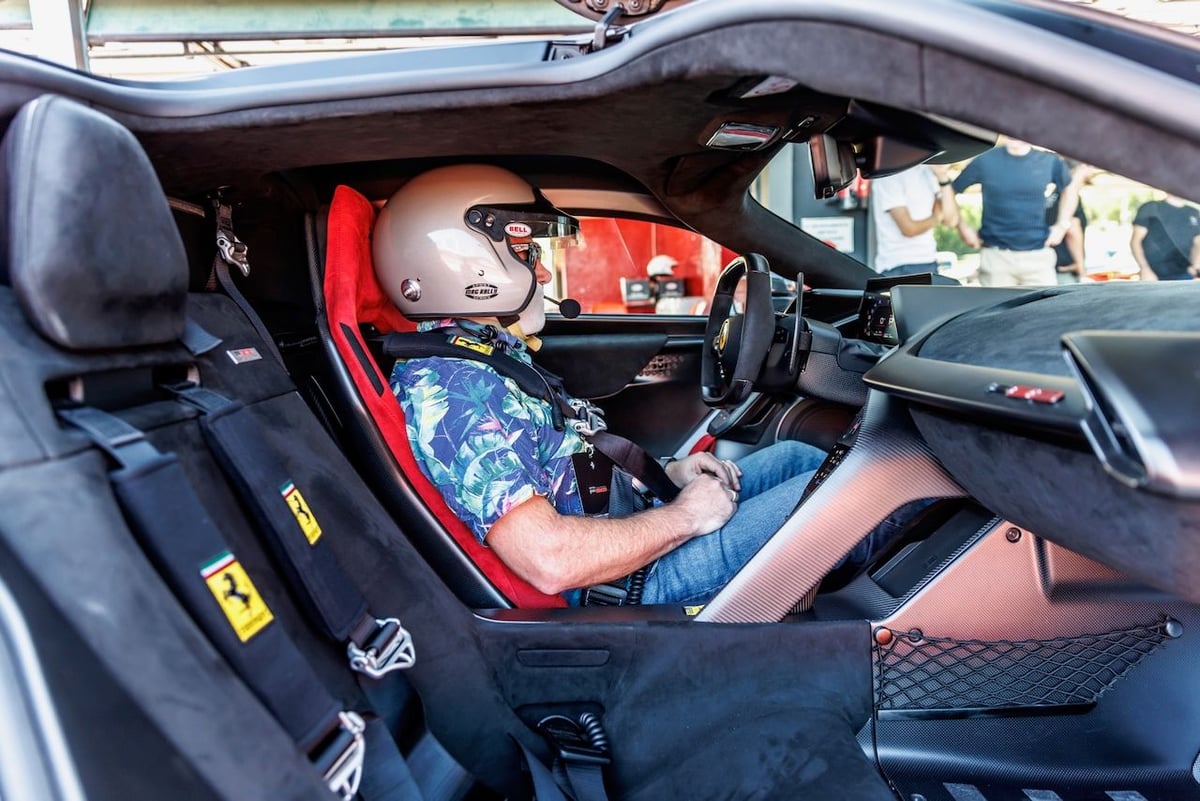
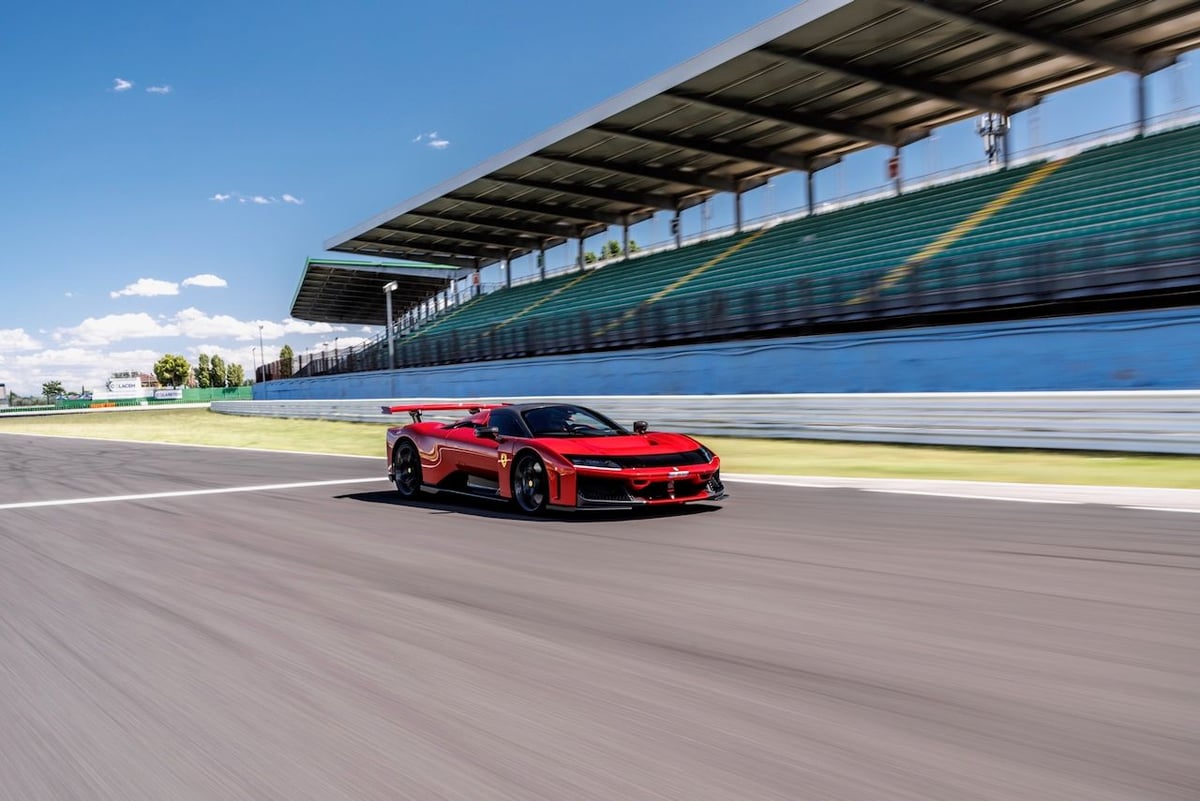
I really wish I hadn’t watched that video before arriving at the media launch — limited to just 20 journalists globally — at Italy’s Misano circuit. And I really didn’t enjoy the pre-drive briefing, where we were told the track was chosen because it includes one corner where you can hit the apex at 250 km/h — the exact speed at which the F80 generates its maximum downforce: over one tonne.
More than anything, I wish I’d blocked my ears when they mentioned the price – seven million Australian dollars – and reminded us that only a handful existed at that point. So please… don’t crash one.
We were also told that the Ferrari we’d be driving had already memorised the circuit, which meant it could deploy its ingenious Boost Optimisation system. Basically, the F80 analyses your lap and decides where to give you more boost out of slow corners, helping you shave time off.
If I hadn’t been in a room full of men – mostly Italians who drive like lunatics for a living – I would’ve asked if it was absolutely necessary to turn on the Boost Optimisation for my laps. Because honestly, I had the feeling the car would be more than fast enough without it.
Of course, I’d be lying if I said I wasn’t both terrified and excited to drive the F80. After all, it’s essentially a better-looking, better-engineered, and far more powerful version of my all-time favourite: the Ferrari 296 GTB.
Both cars are powered by a 3.0-litre twin-turbo V6 hybrid, which makes a hugely impressive 614kW and 740Nm in the 296 – but that jumps to a downright silly 883kW and 840Nm in the F80, which, by the way, Ferrari officially calls a “super car”.
We might think every Ferrari is a supercar, but in Maranello, most are just sports cars – common production models in their eyes. The sacred “super” badge only comes out once a decade or so: starting with the 288 GTO in 1984, then the iconic F40, followed by the F50, the Enzo, and finally the stupidly christened, V12-powered LaFerrari.
That last car was spoken of in hushed tones and sometimes referred to as the greatest car of all time. Yet the F80 – with half as many cylinders and admittedly less aural drama – is a staggering 4.5 seconds a lap faster around Ferrari’s own Fiorano circuit.
A couple more numbers were swirling in my head as I was strapped into the racing harness: the F80 can hit 200 km/h from a standing start in 5.75 seconds (the legendary F40 took 11 seconds), and can brake back to zero in just 98 metres.
Clearly, the forces that were about to be unleashed on my body, and felt through my damp, clammy hands, were going to be quite violent.
My first few laps were both a blur and a revelation. My brain was certain this car would be beyond me – implausible and impossible to drive. I kept thinking, “Surely anyone mad enough to buy one of these gets in and thinks, ‘What have I done? I’m not man enough for this.’”
On one hand, I did initially struggle to get to grips with the acceleration, and just how often you are called on to shift cogs, as the revs rush so quickly and gloriously into the limiter. But at the same time, I was stunned by just how easily you can get all of that vast power to the ground, and how utterly bolted to the Earth you feel, at all times.
A Ferrari engineer told me that the car’s power had reached a point where rear-wheel drive alone wasn’t an option. So, they fitted an electric motor inside each front wheel, creating an on-demand all-wheel-drive system with lightning-fast torque vectoring, ensuring the F80 never feels like it wants to bite.
There’s no tail happiness, no leery sideways lurching under hard acceleration. It just grips, and goes, like nothing I’ve ever experienced. I’d driven a McLaren 750S weeks earlier and found its power overwhelming, but this Ferrari made it feel almost pedestrian.
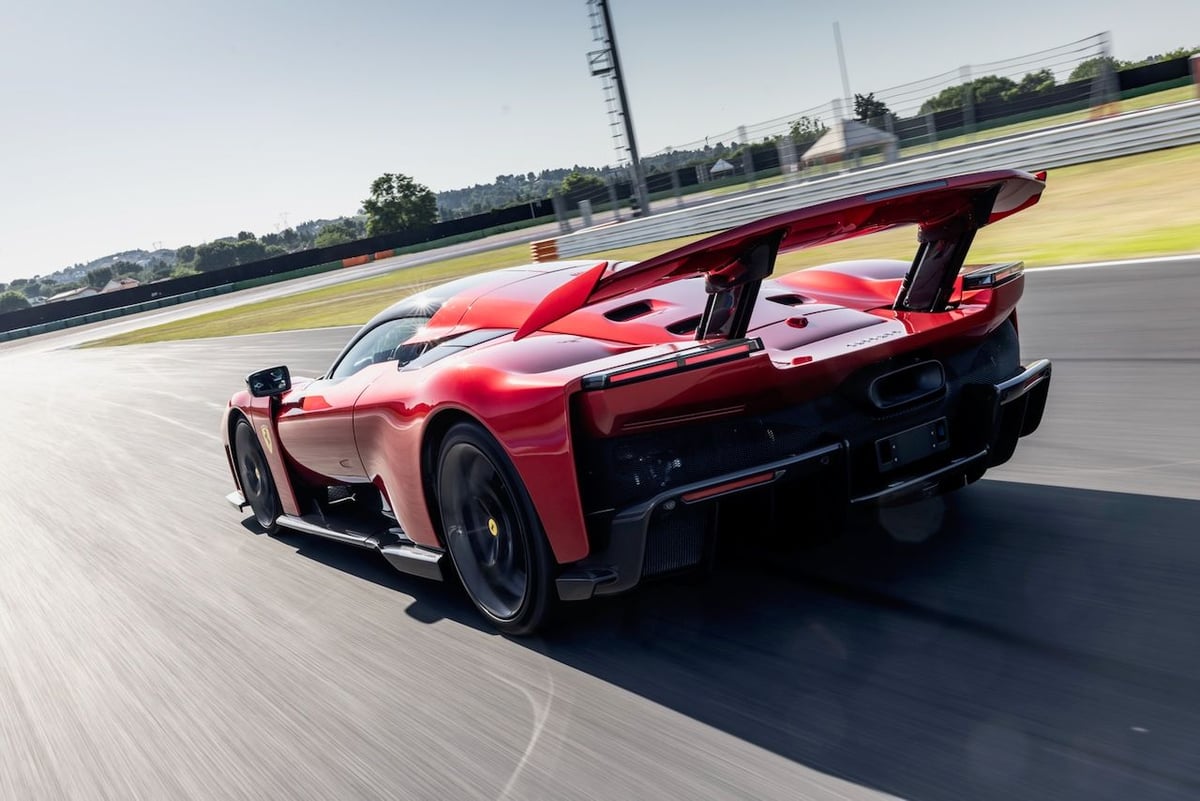
Downforce – with this car’s incredible active aero and DRS-like rear wing – is a magnificent thing, and there’s plenty of it. I worked my way up to one of Misano’s fast corners and eventually hit it at 220 km/h (I sat next to a test driver who flew through at 270 km/h; he’s got balls like boulders). The whole time, I felt utterly, gravitationally glued to the track.
I began to realise that anyone lucky enough to own an F80 – and only 799 people worldwide will, including around 20 in Australia (or so we’re told) – will find themselves both thrilled and surprised.
Its speed is beyond scintillating, it genuinely makes the 296 seem a bit ordinary. But it’s how that speed is delivered and accessed that makes this the greatest car I’ve ever driven. It makes you feel superhuman.
It’s also worth mentioning just how stupendous the brakes are, bringing you down from ridiculous speeds (we saw over 300 km/h on a public road at one point – though I wish I hadn’t, since I was in the passenger seat). They also provide fantastic feel and modulation.
The F80 looks absolutely incredible and presents both immaculately and functionally inside, thanks to its unique seating position that shoves your passenger sideways and slightly back – you definitely don’t want to be sitting there – so you feel totally at the centre of everything.
After a full day of smiles and sweaty track action, we hit the Italian roads the next morning – where I quickly realised that driving a $7 million machine surrounded by carefree and careless motorists is, unsurprisingly, extremely stressful. This Ferrari is just too much, and too fast, for the real world.
On the track – or your favourite back road (closed for your motoring enjoyment) – the F80 is, quite simply, the greatest car the world has ever seen. A driver’s car, an engineering masterpiece, and a work of art.
And yes, I’d even pay $7 million for one, if I had the money (and if they ever returned my calls).