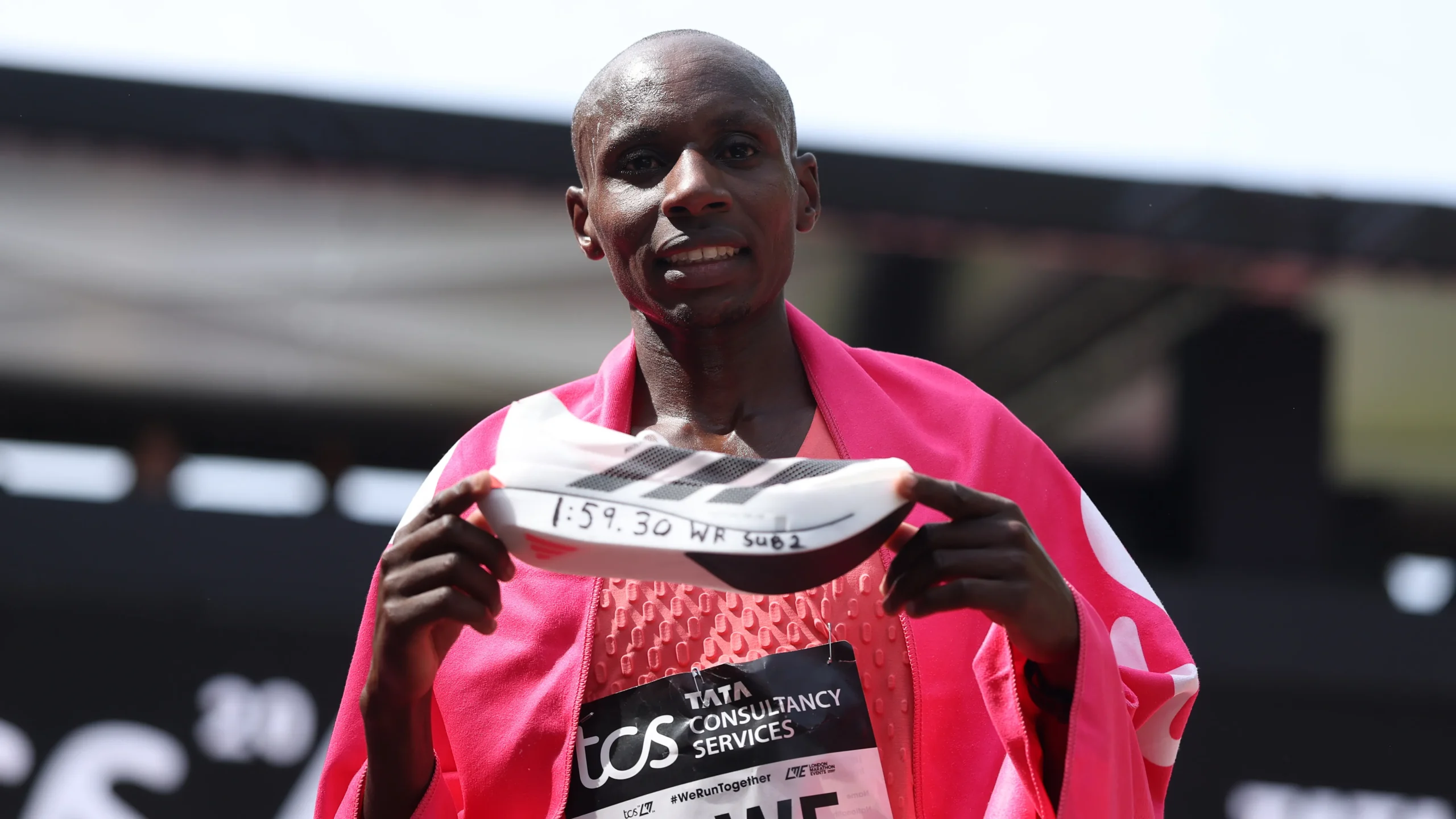

- Sabastian Sawe delivered the first officially ratified sub-two-hour marathon at the 2026 London Marathon, wearing the Adidas Adizero Adios Pro Evo 3.
- The “Race to Zero” has turned elite marathons into a proving ground for billion-dollar innovation cycles with global bragging rights attached.
- What happens between Adidas and Nike at the front of the pack is rapidly shaping what everyday runners will wear within just a few seasons.
There’s an old saying that we teach little kids. “Take your time; it’s a marathon, not a sprint.” But after what happened in London on Sunday, I think it’s fair to say we might need to find a new adage.
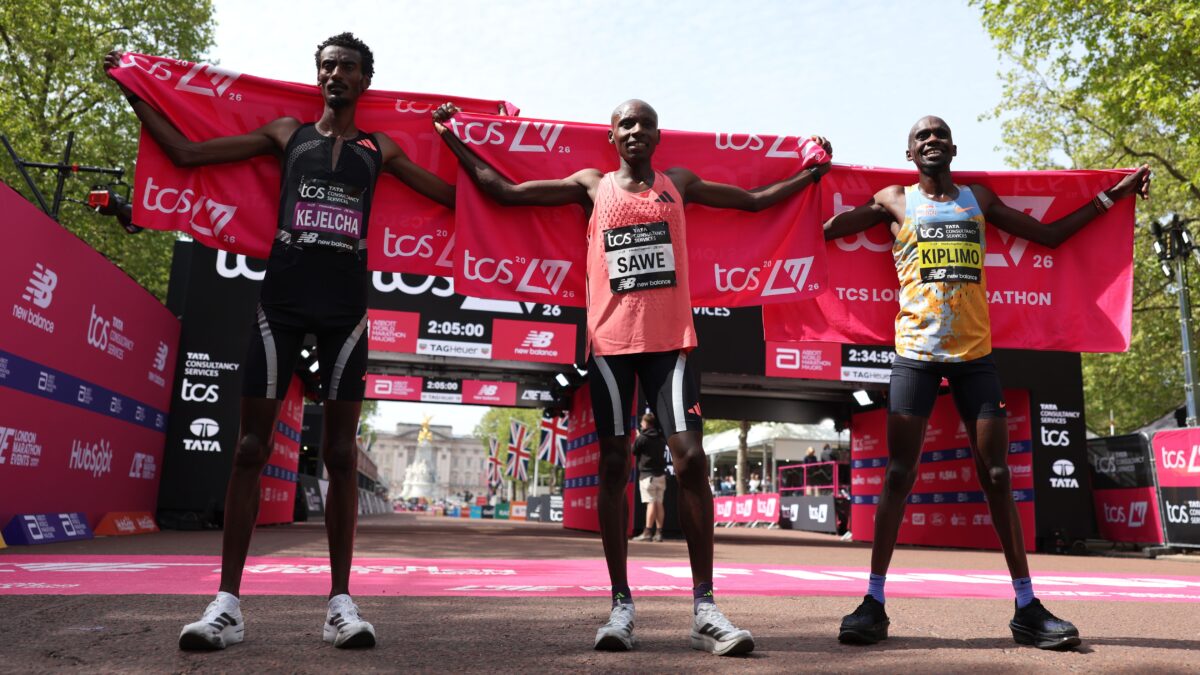
This year’s London Marathon had not one, but two record-breaking finishers who failed to win the event. Read that again. Two runners – Yomif Kejelcha and Jacob Kiplimo – finished in 1:59:41 and 2:00:28, respectively, and only managed to land second and third on the final standings.
In any other race in history, third place would have been the fastest marathon ever. So dominant was the historic race-day performance from Kenya’s Sabastian Sawe that morning in the London sunshine, so total his annihilation of an already-elite field, that two world-record runs were left in his wake.
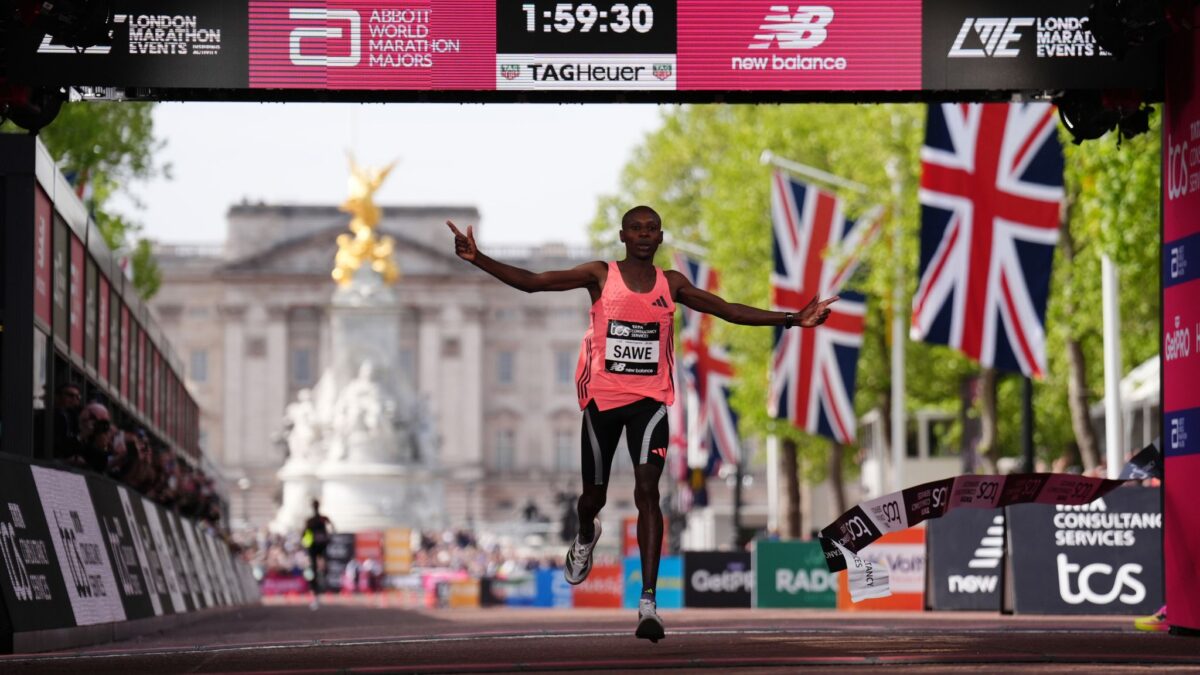
When Sawe crossed the finish line in 1:59:30, he became the first human being in history to run an officially ratified marathon in under two hours, surpassing the late great Kelvin Kiptum’s Chicago record by 65 seconds. Eliud Kipchoge had run 1:59:40 in Vienna in 2019 (following an initial failed attempt), but under controlled conditions with rotating pacemakers and even a laser guide to follow.
It was extraordinary, though it wasn’t ratified. What Sawe managed as he crossed the finish in the English capital was both. And on his feet: a pair of Adidas Adizero Adios Pro Evo 3, the German brand’s latest offering to the supershoe arms race; a shoe people are confidently calling the fastest ever, and they weigh less than a banana.
Before we get to the shoe, we need to sit with what Sawe actually did, because the statistics require a moment of quiet contemplation before they make any kind of sense. This one’s for the running nerds in the room.
Sawe ran this year’s mammoth distance of 42.195 kilometres at 2:49 per kilometre. That’s 26.2 miles at 4:33 per mile. For context: the world record for a single mile is 3:43. Sawe ran within 50 seconds of that pace, for 26 consecutive miles. His average speed across the entire course was 21 km/h. I looked at my gym treadmill this morning when I was flicking through sources for this piece, and it doesn’t even have a setting that high.
To understand this better, I need to put myself in the frame. I’m an amateur runner; I’ve run 5Ks, 10Ks, halfs, and my first full marathon in Sydney last year.
On a good day, I can manage a 22-minute 5K. I attempted a sub-20 5K for the sake of this article, and I was desperately reaching for the ‘Cool Down’ button before I even hit the 4km mark. Sawe ran his 5km splits in approximately 14 minutes and 10 seconds… and then proceeded to do it eight times in a row.
Someone, somewhere, did the maths on London’s hireable Lime scooters, which top out at 12.5 mph (~20 km/h). At full throttle, never braking, never backing off, a scooter rider attempting the marathon course would have been more than a mile behind Sawe at the finish line. A man on foot, outrunning a motorised scooter, flat out, over 26.2 miles. It’s absolute madness.
Sabastain Sawe’s London Marathon Time
| Distance | Time | 5km split |
|---|---|---|
| 5km | 14:14 | 14:14 |
| 10km | 28:35 | 14:21 |
| 15km | 43:10 | 14:35 |
| 20km | 57:21 | 14:11 |
| Half | 60:29 | — |
| 25km | 1:11:41 | 14:20 |
| 30km | 1:26:03 | 14:22 |
| 35km | 1:39:57 | 13:54 |
| 40km | 1:53:39 | 13:42 |
| Finish | 1:59:30 | — |
Which brings us, inevitably, to what they were wearing, the latest supershoe to break another world record in spectacular fashion: the Adidas Adizero Adios Pro Evo 3.
For the enthusiasts who like to get into the weeds of the spec sheet, myself included, the Adizero Adios Pro Evo 3’s weight reduction is the headline. The shoe weighs just 97 grams, roughly half the weight of a conventional running shoe, and comes in at around 30% lighter than its predecessor, the Evo 2.
The industry calls this the “Race to Zero”. It’s the push toward the theoretical minimum weight at which a shoe can still function as a shoe.
Most engineers put that floor at around 50 grams. The Evo 3, at 97 grams, is roughly halfway there. It’s certainly not an enviable task to see how much fabric can be stripped away from the shoe, or how much energy can be effectively stored in the sole. But, it’s fair to say, every gram saved at the elite level is worth billions in the mainstream market that follows. I guess that’s why I’m not employed in Adidas’ R&D department.
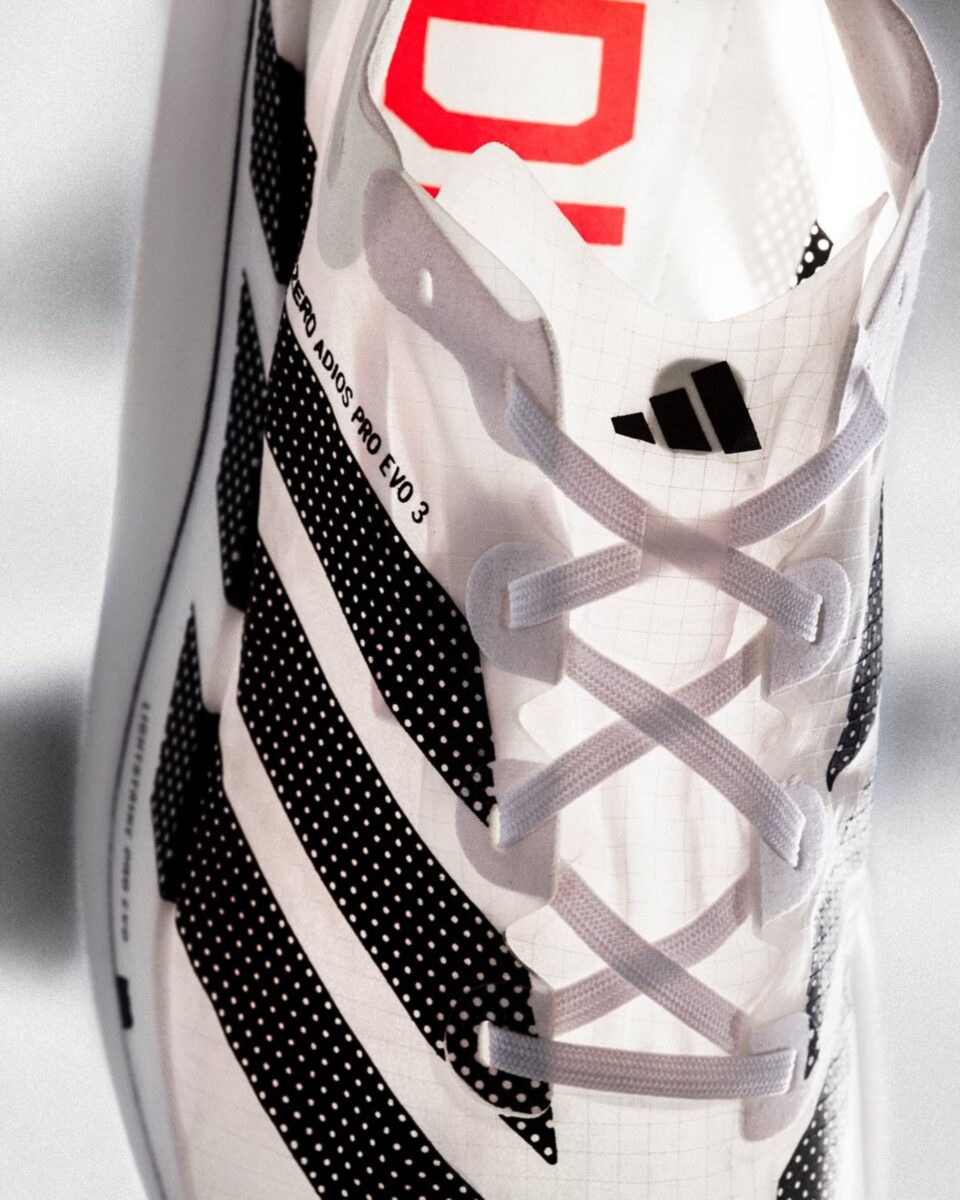
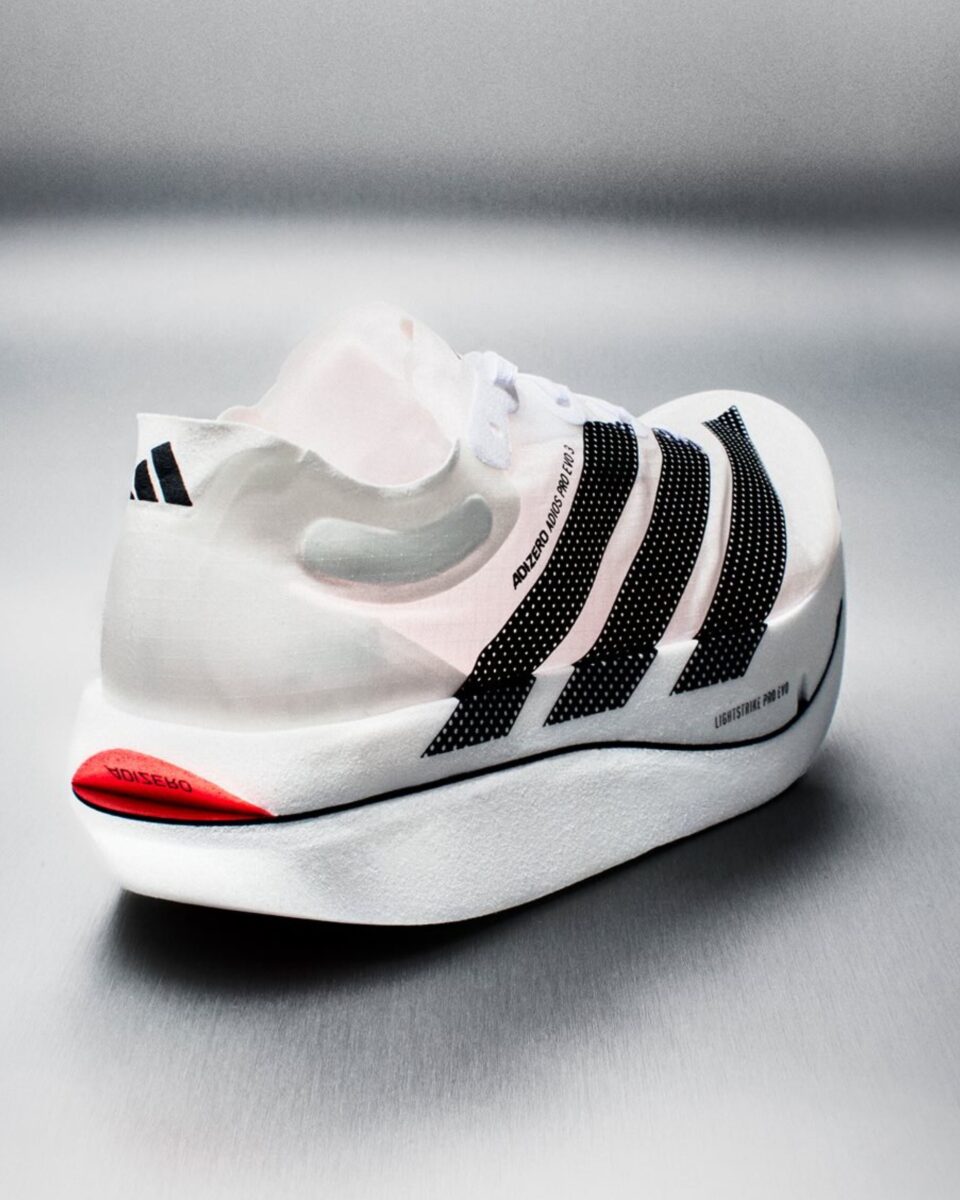
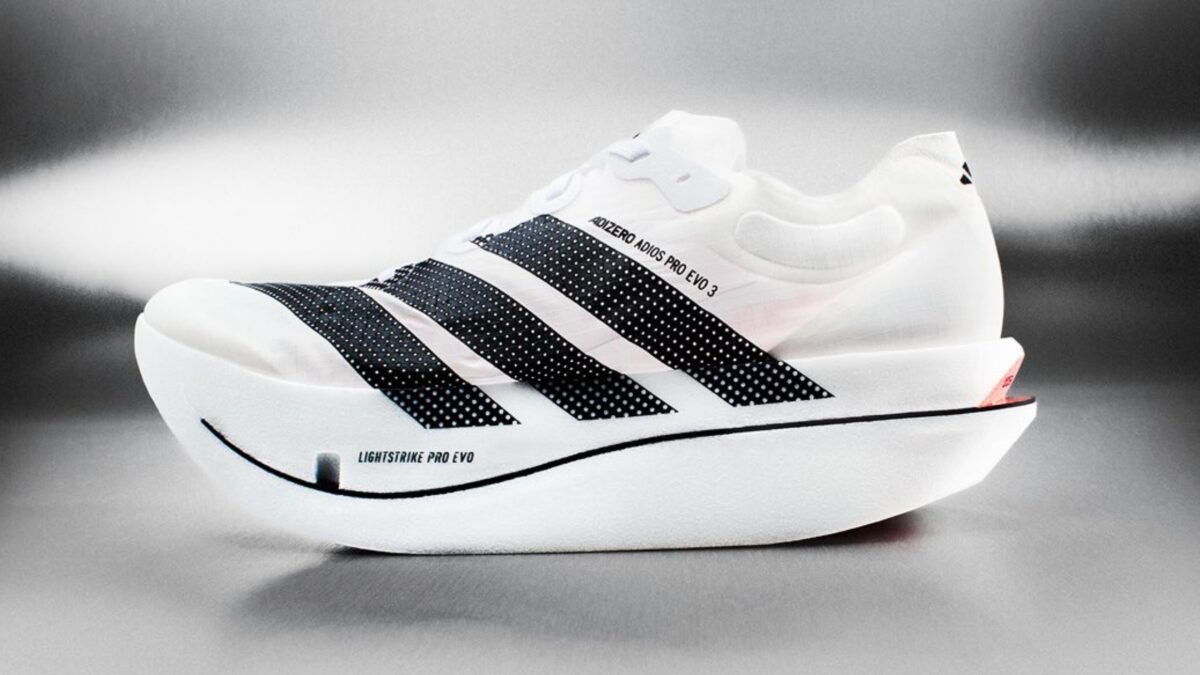
But the story behind this 2026 monster’s engineering is something else entirely. Taking its inspiration from the absurdly light sail fabric used in kite-surfing, Adidas has seemingly looked to reduce weight across every aspect. The laces are lighter. The upper sole is lighter. The U-shaped carbon fibre plate running the length of the shoe is – you guessed it – lighter.
Even the sole of the shoe, constructed from the brand’s proprietary Lightstrike Pro foam – which injects nitrogen into the compound under pressure to expand billions of microscopic cells within the material – is ultra-light and springy. The foam absorbs the impact of each prevailing stomp, stores it, and returns energy at toe-off, functioning as a kind of biological assist, which, no matter where you find yourself along a monster effort, gives the runner an extra push from the ground up every single stride.
The Evo 3 is not, however, built for longevity, degrading after just 30 miles (~48 kilometres) by design; it is essentially a single-race instrument, engineered for one day of maximum performance. Perfect for smashing records at one of the world’s biggest racing events. Not so great for the everyday Centennial Park punter looking to update their runners’ rotation.
This is worth understanding when positioning it against its closest competitor, Nike’s Alphafly 3, which, coming in at around AU$400 compared to the Evo 3’s AU$750, lasts approximately five times longer and remains one of the fastest shoes on the market.
Third-placed Kiplimo ran in a prototype version of what is believed to be the Nike Alphafly 4, not yet available to the public. So clearly, there will be some more headlines from the American brand in the coming months, and speaking with someone from the Nike team this week, runners may want to mark their calendars for the end of this year. Though nothing to write home about (yet).
Of course, despite existing in the same conversation, the Evo 3 and the Alphafly 3 are not really the same product. One is a disposable race-day weapon. The other manages a full training block.
The era began in 2017 when Nike launched the Vaporfly 4%, named for the running economy improvement it claimed to offer, dominating elite marathoning for half a decade.
By late 2017, the Vaporfly 4% was worn by winners of the Boston, Berlin, Chicago, and New York City marathons. In Berlin in 2018, Eliud Kipchoge set a new world record of 2:01:39, wearing the Vaporfly 4%; Brigid Kosgei broke the women’s world record with 2:14:04 a year later in Chicago. It felt as though the battle lines had been drawn.
So Adidas came back with the Adizero Adios Pro line in 2020, intended as the direct competitor to Nike’s all-conquering supershoe, debuting its now-ubiquitous Lightstrike Pro foam. The Evo hit the market just three years later. Sawe, notably, won last year’s London Marathon in the Evo 2, so the Kenyan’s win seals back-to-back first place finishes for Adidas, with back-to-back generations of the same shoe line, each iteration lighter (and more importantly faster) than the last.
But here’s what makes all of this bigger than the decision-makers across European and U.S. boardrooms. Today’s running is no longer a niche sport, reserved for the elite.
It permeates every major city – in your packed Friday morning run clubs over Sydney’s Harbour Bridge, through local brand activations, through the quiet ritual of millions of ordinary people lacing up before the rest of the world wakes up. We’re all talking about the shoes Sawe wore on his feet as he crossed the line in London.
Within a generation of product cycles, the technology that carried him to 1:59:30 will be under the feet of people chasing their first sub-60-minute 10K. Elite performance will always filter down through the local running culture.
So whilst Sabastian Sawe and Tigst Assefa are the story of Sunday, the shoes they wore have become something else entirely.
It’s estimated that the high-performance running market, worth an estimated US$7 billion (~AU$9.8 billion), will reach US$16.2 billion by 2034. The shoes we wear have become a commercial embodiment of an arms race that seemingly has no obvious finish line – an engineering sprint disguised as a consumer product.
Yes, there’s an old saying that it’s a marathon, not a sprint. But Sawe just proved that particular adage redundant. And for the brands chasing each other toward the theoretical floor – toward whatever the Evo 4 or the Alphafly 4 turns out to be – something tells me the “Race to Zero” is very much a sprint. Not a marathon.