

This story originally appeared in Volume 6 of B.H. Magazine, pre-order your copy of Volume 7 now.
Every morning, Dennis Benson bakes himself a loaf of bread. Nothing fancy, just a plain loaf prepared in a domestic bread-maker and finished in the oven, sliced thick, then spread with butter and a smear of rosella jam. It’s a ritual, unhurried and grounding, performed by a man who has always believed bread matters. He baked it during lonely months living and working in lighthouses. He baked it as a bricklayer. And he still bakes it every day now, into his eighties.
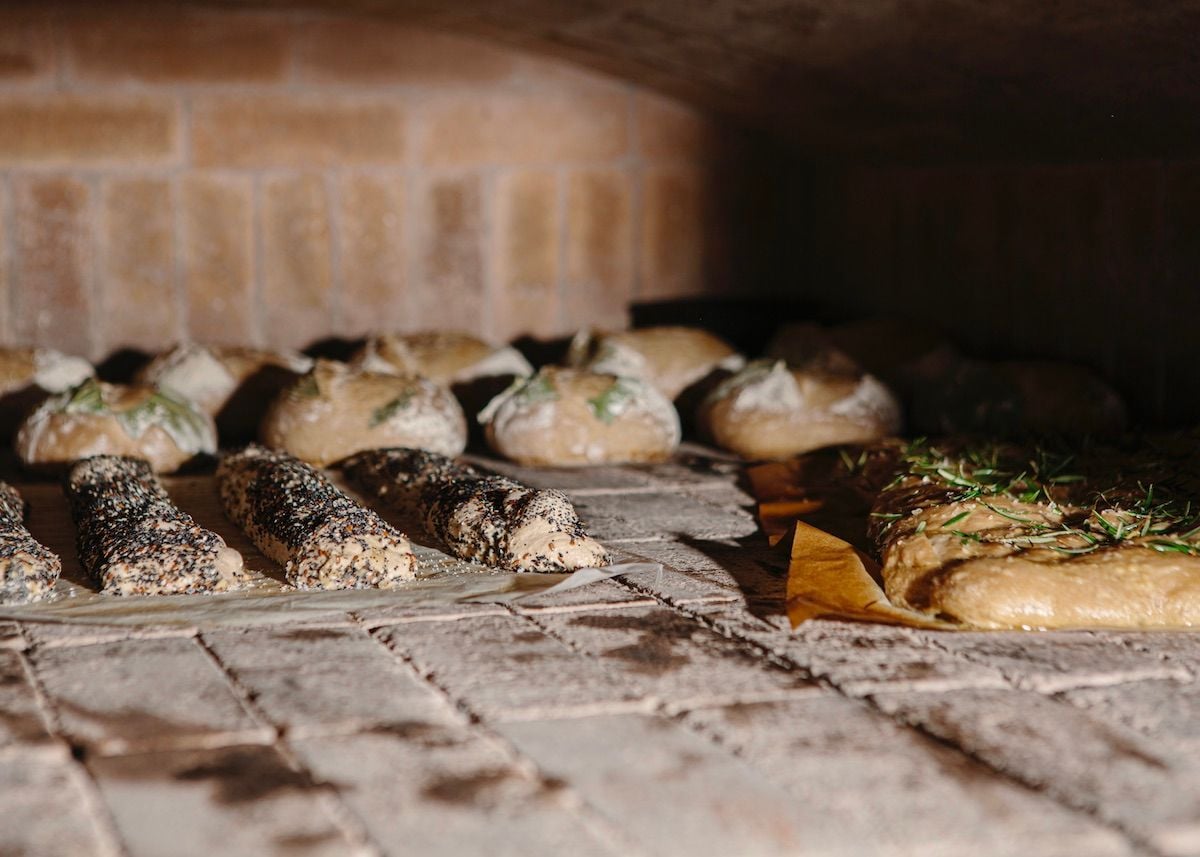
What Benson has given others, though, is bread on a different scale. For decades, he’s built Alan Scott-style wood-fired ovens; arched, thick-walled, heat-retaining chambers of brick, stone, and sand that turn fire into flavour. These are not off-the-shelf appliances. They’re structures, as permanent as monuments, assembled by hand. Sometimes, they’re built with second-hand convict bricks or sand gathered from a faraway beach. They’re ovens that breathe with fire and then radiate heat long after the flames are gone. From inside them, bread and roasts and vegetables emerge transformed.
“I was a tradesman,” recalls Benson. “I had a period of lighthouse keeping, then they shut the lighthouses down, so I went back to bricklaying. That’s when I met a guy called Alan Scott.”
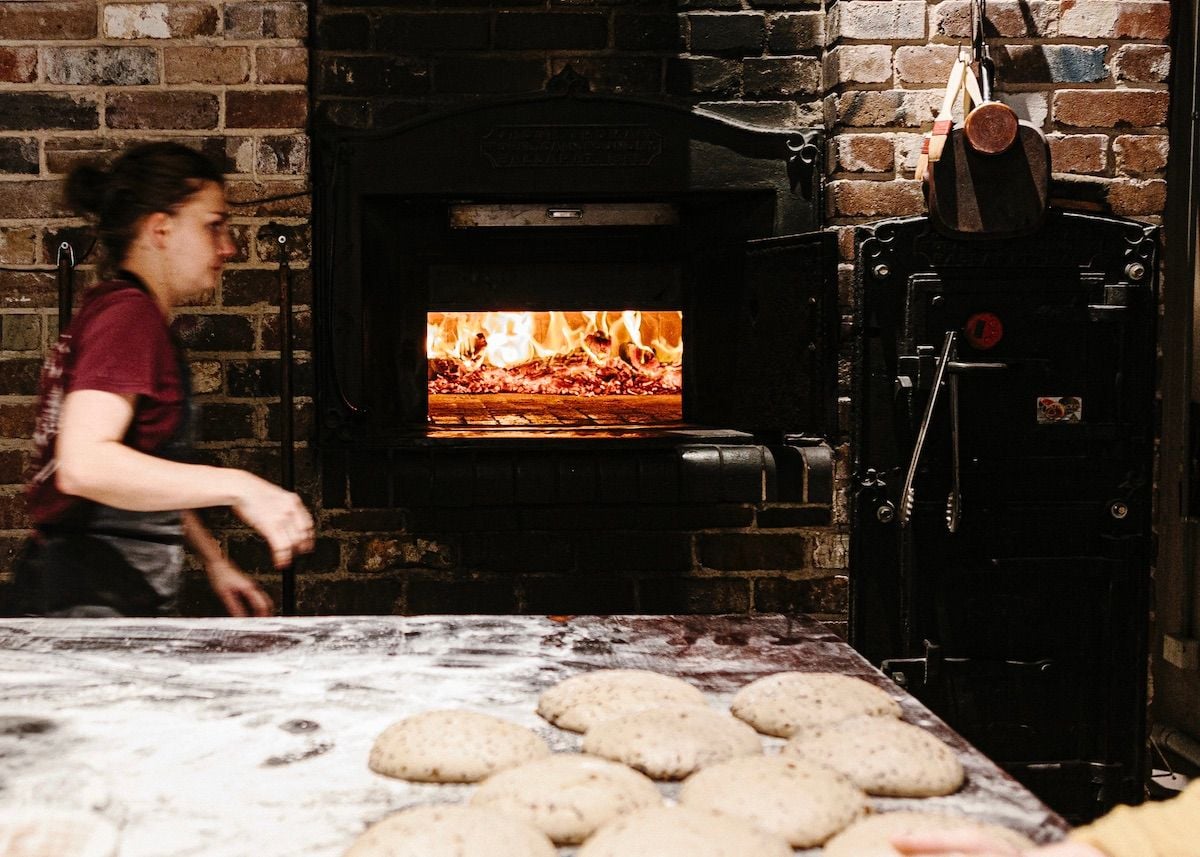
Scott, a Tasmanian silversmith turned American-based oven designer, had been drawing up plans to revive traditional retained- heat masonry ovens – the kind that once sat at the heart of communities. Benson met Scott while restoring a heritage oven in Laidley, Queensland, and soon began building ovens with him for Sonoma Bakery in Sydney.
“That’s when I first got tangled up with Alan Scott and his ovens,” says Benson.
Scott’s designs married old ideas with modern materials: thick walls of firebrick, careful layers of insulating vermiculite, hearths that held heat like a bank vault. Fired once, the ovens could bake for hours – turning out bread in the morning, pastries by midday, and slow-cooked meats overnight as the heat faded.
To Benson, the genius was in its simplicity. “It’s all down to the three heats these ovens deliver,” he says of the combination of convection, conduction, and radiation. “You can’t beat it.”
From there, Benson’s career unfolded on a national scale. He was invited to build ovens in Sydney, Cairns, Victoria, and South Australia, on Bruny Island and across Tasmania, for names that would become synonymous with Australia’s artisan food culture: The Agrarian Kitchen, Bruny Island Cheese Co., Sonoma, Cherry Moon General Store, and Fat Pig Farm, plus dozens of others.
Despite his high-profile clients, Benson never advertised and never sought commissions. “They found me or tracked me down,” he says of his clients. “The taste of bread from a wood- fired oven can’t be beat, so if they’re interested in sharing that with their customers, then that’s what matters to me.”
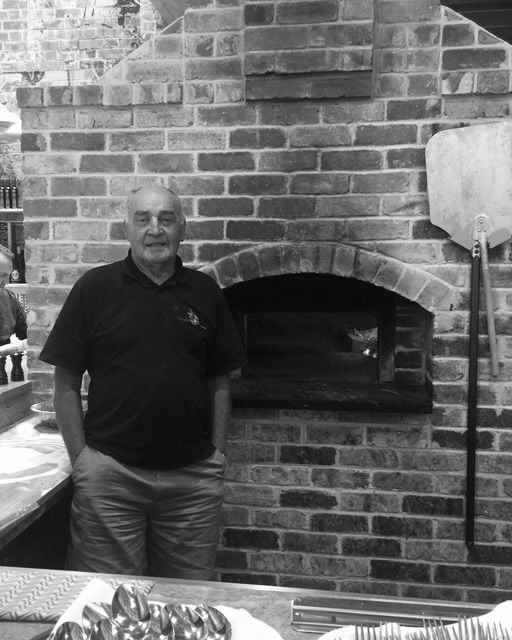
For Matthew Evans of Fat Pig Farm, the choice was obvious. “We call our oven the ‘Dennis’ because for us, it’s a monument to his skill,” says the chef, farmer, and author. He remembers Benson working in the sleet of a Tasmanian winter, adjusting bricks by instinct, solving problems no set of plans could anticipate. “Watching him adjust as we went amazed me,” says Evans.
The result was an oven big enough to roast two whole pigs and six chickens, or 22 loaves of bread at once. “We talk about bakers as artisans,” says Evans, “but the original artisan is someone who can build an oven like that.”
Kimmy Gastmeier of Sydney’s Cherry Moon bakery searched for years before she finally found Benson. At the last possible moment – her landlord threatening to cancel the project – she discovered his name on a supplier’s invoice. He appeared, as if conjured, and spent three weeks building the oven Gastmeier ended up naming Apollonia (after a character in the Prince film Purple Rain).
“It was the most beautiful three weeks of my life,” Gastmeier says of the time spent with Dennis and his wife and collaborator, June. “I was getting my hands dirty while I was having these beautiful conversations. Everyone really took care of each other.”
Even now, when she lights the fire, she hears Benson’s voice in her head: Don’t worry about the flames. It’s all about the coals.
Cooking in one of Benson’s ovens isn’t a matter of pressing buttons or following timers. For both Evans and Gastmeier, it’s about instinct, rhythm, and feel. Evans describes it as “being in a relationship”. The cook has to learn the oven’s nuances – when to add wood, and when to let it rest.
At both Fat Pig Farm and Cherry Moon, the oven isn’t a passive tool but a partner in the work, one that insists the baker be present, alert, and connected every single day. It’s a mode reflected in Benson’s building style, where he insists on patience, obsesses over proper chimneys and keystones, and sprinkles sand between bricks by hand. He lights the first fire in every oven so he can be sure it draws right. And he never forgets what it’s for.
“Do you know how many people have enjoyed bread or something delicious from those ovens?” he asks, almost overwhelmed by the thought. “A lot of people. And if the oven wasn’t there, they could never experience it.”
Dennis’s ovens are not just practical; they carry stories in their bricks. At Fat Pig Farm, the oven’s keystone (the central, topmost stone or brick in the arch) features what Evans and Benson gleefully call “the Tasmanian tiger print”, a convict-made detail, though more likely left by a wombat.
In Sydney, Apollonia’s facade was constructed around an 1869 Scotch oven door salvaged from Ballarat, restored to working order and slotted neatly into Benson’s brickwork. And in almost every build, Benson insists on using reclaimed bricks (“Old bricks are better bricks,” he says), carrying the imprint of past hands into present loaves.
But if his work is thick with legacy, the future feels thinner. Benson is 82 now and no longer building. “There’s nobody there to pass it all onto,” he says, matter-of-factly.
Evans worries about the same thing. “Who comes after Dennis?” he asks. “We need people to keep these ancient things alive, not as museum pieces, but because they’re really good ways to cook.”
Gastmeier, too, admits the knowledge feels fragile, passed through conversations, late-night phone calls, and the memory of his hands at work. When her oven needed routine repairs years later, she climbed inside the still-warm chamber while Benson, outside, guided her through each move. “It was incredible,” she says. “I’d love to do it with him every time, but I’m going to need to know how to do it myself.”
There’s something elegiac in the thought. Australia once had a wealth of Scotch ovens, huge communal brick chambers fired by wood or coal that offered whole towns the opportunity to bake bread. Most were bricked up or bulldozed decades ago.
Scott’s blueprints and Benson’s builds brought that knowledge back just in time for a new wave of bakers, but the tradition is again at risk of thinning out. In an industry quick to praise chefs and producers, the role of the oven builder has remained invisible, though without it there would be no bread worth writing about.
Benson doesn’t spend much time on legacy. What matters to him is the fire itself, the curve of the arch, the bread on the other side. He’s always chosen jobs on instinct, saying yes wherever there was potential for good bread and good community. “If they can make good bread in it, that’s what it’s about,” he says.
Every day, Benson still prepares his loaf in his small breadmaker. But out there, across Australia, his ovens have baked for hundreds of thousands. Multiply that across decades, and the number runs into the millions.
Benson doesn’t need to see the bread to know. He imagines it instead: fresh loaves torn open, crusts shattering, families fed, tables noisy with satisfaction. The joy he finds in a simple slice of bread has, through fire, brick, and patience, reached more people than he’ll ever know.