
Even if you never did squad swimming, you almost certainly know someone who did – probably because they never shut up about how tired they were each morning.
We all know how gruelling swimming can be. From the 5 AM sessions every day of the week, to the endless kilometres following that black line at the bottom of the pool, it’s a sport that celebrates toughness – both physical and mental – above all else. Something that, throughout his career, Australian Olympic Champion Cameron McEvoy has bought into.
For more than a decade, McEvoy saw toughness, not thoughtfulness, as the difference between Olympic gold medals and disappointment. From the age of four, he was in the pool with his brother, logging countless hours of training in pursuit of speed and glory until the weeks after the Tokyo Olympics, when he almost quit the sport entirely.
Instead, he returned with a different belief: that almost everything his coaches had taught him was wrong.
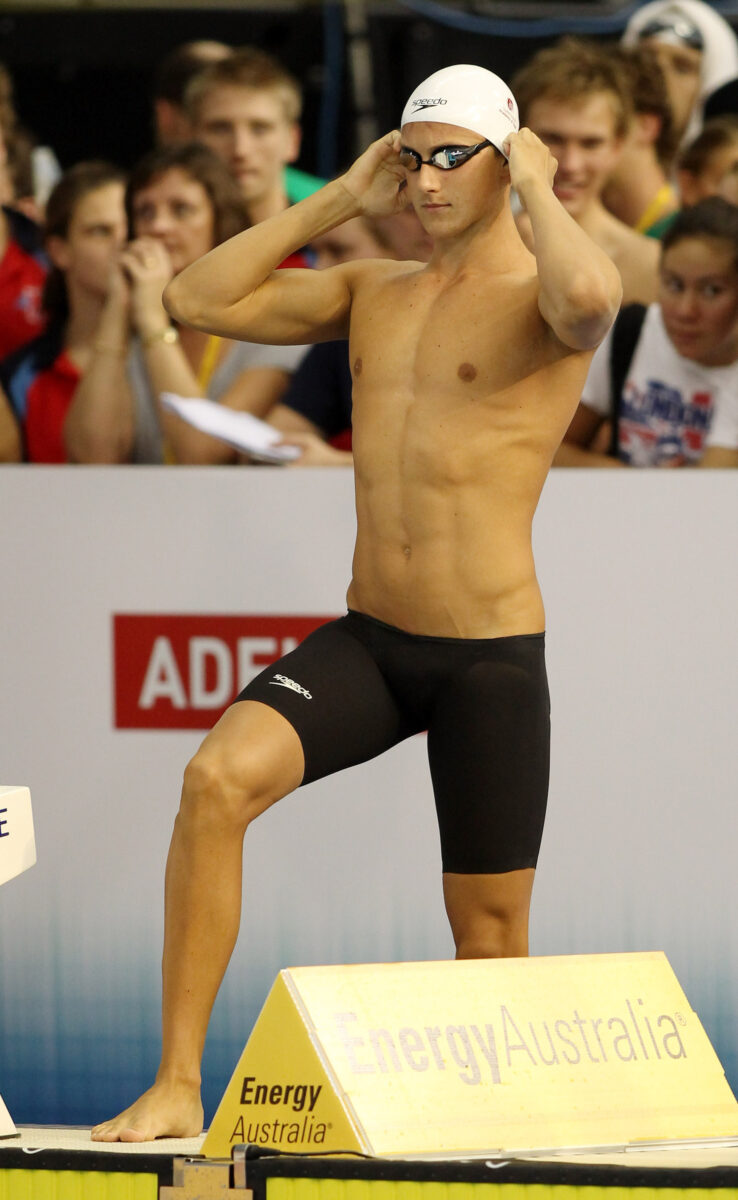
Nicknamed “The Professor” (thanks to his degree in Physics and Mathematics), he returned to the pool with fresh eyes and a burning desire to reinvent the sport with a revolutionary new data-driven approach.
Now, he’s the fastest human being to ever swim 50 metres, clocking a time of 20.88 seconds in Shenzhen in March 2026, shaving three hundredths off a world record that had stood since 2009.
This isn’t a story about natural talent (though Cameron McEvoy has plenty of it). It’s a story about how unchallenged orthodoxies can burn out athletes, fail to realise potential, and ultimately limit the progress of Australia’s favourite Olympic sport.
Building On The Wrong Foundation
McEvoy made his first Australian senior team in 2012, qualifying for the London Olympics at the age of 17. Over the next nine years – which included Rio 2016, Tokyo 2020, and a swag of relay medals and individual world championship results – he became one of Australian swimming’s most recognisable faces. On paper, he’d had a solid career. In his own mind, however, something wasn’t quite where it needed to be.
“It wasn’t a bad career,” McEvoy tells B.H. “However, relative to where my potential was, I definitely didn’t reach it in those years.”
The clearest example came at the 2016 Rio Olympic trials, held in Australia three months before the Games. McEvoy swam 47.04 in the 100m freestyle, which was a non-super-suit world record at the time, and over a second faster than anyone else in the world that year.
At the Olympics themselves, he swam 48.1 in the final. The gold medal went to fellow Aussie Kyle Chalmers in 47.5, and McEvoy finished in seventh.
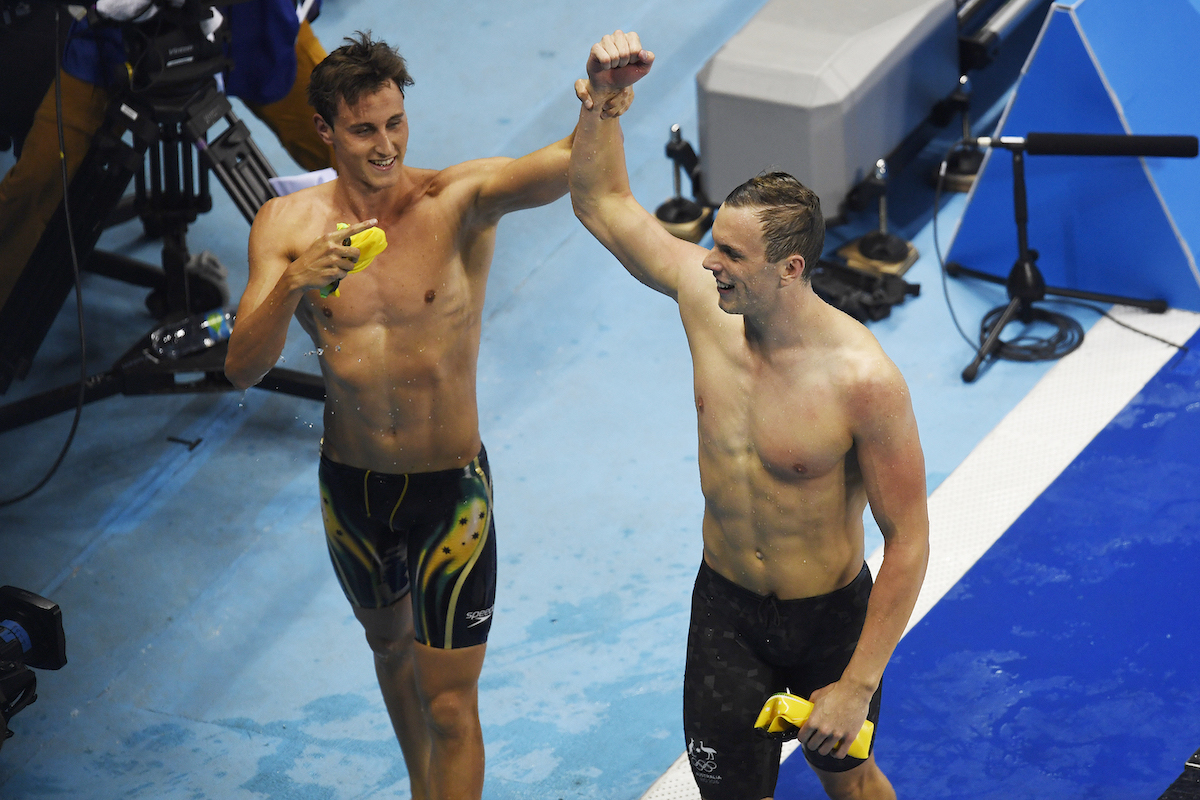
The opinion of the Australian team’s coaching staff at the time was that his struggles were mainly psychological, where big meet nerves meant failing to replicate his trials form. McEvoy trusted them at the time, but in hindsight, he sees it differently.
“My understanding of it is this: we tapered down, I raced at those Rio Olympic trials, I swam really well, and then the idea was, ‘okay, let’s get back into training, we’ve got three and a half months, so let’s do what we did in the lead-up to these Olympic trials, but see if we can fit more of everything in.’ My general aerobic training went up, and basically all elements of my training just increased in volume.”
“We had the idea that more volume equals faster.”
Cameron McEvoy, Australian Olympic Swimmer
What followed was a textbook case of overtraining. Training intensity increased because McEvoy was at his fastest, but volume increased simultaneously. He started missing training targets he’d have comfortably hit just weeks earlier, and his confidence took a timely hit. It resulted in a negative cycle: missed targets prompted the coaching staff to prescribe more work, which further deepened the fatigue.
“It becomes almost like this psychobiological flywheel,” McEvoy continues. “I’m building up this fatigue from the starting point of overdoing it, which is then making me panic and buy into the idea that I actually need even more work because I’m falling behind. Then I double down on more work, and that’s the very thing that’s causing the issue.”
To understand just how much work McEvoy was doing in those years, a useful rule of thumb is that the ratio between swimming and running is about 1:4. If 100 metres of swimming is the equivalent of a 400-metre run, by the time you wind it up to the 30 kilometres a week in the pool (McEvoy’s baseline for his entire career from 2012 to 2021), you’ve got the metabolic equivalent of running 120 kilometres.
At peak blocks, he was swimming 60 kilometres a week (the equivalent of running 240 kilometres), while also doing three gym sessions and the occasional session on a spin bike. All this, in preparation for a race that lasts less than 50 seconds.
“That’s standard,” he says. “It doesn’t matter what event you’re doing or what stroke you’re doing. It’s wild to think about from a sprint point of view.”
A New Beginning
When Tokyo 2020 came around, Cameron McEvoy’s fourth Olympics, he swam 22.3 in the 50m freestyle, well below his best, and was eliminated in the heats. From his perspective, it was over.
“In my head, I had effectively quit the sport.”
Cameron McEvoy, Australian Olympic Swimmer
McEvoy took three months off from all training, got bored, and started casually visiting a rock-climbing gym, where he noticed a training group of serious climbers and asked to join in. By watching them closely, McEvoy realised they weren’t just doing a set of exercises; they had an entirely different philosophy of strength development.
“I learnt their philosophy of strength training,” he says. “It started because I wanted to improve my mobility. I wanted to improve my callisthenics-style movements, I wanted to hit a front lever, and I wanted to get my max weighted pull-ups as heavy as I could.”
Seeing the climbers doing front levers with apparent ease showed him how underdeveloped his strength was relative to what they considered a baseline movement. Swimmers obviously aren’t weak, but the kind of strength that actually matters – pure power output, strength-to-weight ratio, the ability to exert maximum force quickly – wasn’t something he or his swim coaching staff had ever focused on.
“I couldn’t help but try to recontextualise that philosophy into swimming,” he tells B.H. “And I ended up getting to a point where I’d think about how you’d apply some of these strength philosophies to a 50 freestyle, and I realised the weekly training schedule would look extremely different.”
“That was the initial insight. If this were actually true, then what the hell is going on in the swimming world, and why aren’t we training like this? The more I got into it, the more I realised it made such logical sense. I just had to give it a shot.”
Finding A Lane
The first problem with returning to swimming with an entirely different approach was a practical one: no coach would touch it. Cameron McEvoy contacted a few different coaches across Australia and was routinely turned away. That was, until he finally met a Brisbane-based coach called Tim Lane (who arguably boasts the most appropriate name for a swimming coach I’ve ever heard).
McEvoy jumped back into the water in October 2022 with a goal that wasn’t a world record or an Olympic medal.
“My only goal was I’d love to go 21.9 for a 50 free again,” McEvoy notes. “Because I hadn’t been under 21 since 2019. I was 22.3 in Tokyo, and I just wanted to feel that again.”
The early months brought their own inherent challenges; not because McEvoy wasn’t fit, but because he’d spent more than fifteen years perfecting a technique optimised for long, slow swimming – and it had to be completely rewired.
He also had to learn to sit higher on the water, which, while adding 15 kilograms of muscle, doesn’t necessarily make great sense from a physics perspective. As you might expect, drag in water increases approximately with the square of velocity, so the faster you go, the more dramatic the drag penalty for every kilogram you have in the water. McEvoy’s solution wasn’t to be smaller, but to be higher.
“Instead of trying to get faster while moving through the water, it’s much easier to just reduce your drag by not being in the water,” he says. “Like speedboats: the faster a boat goes, the higher it’s sitting in the water.”
The Cameron McEvoy Method
Between the Tokyo and Paris Olympics, Cameron McEvoy essentially spent three racing seasons in a mode of trial and error. From a training perspective, a typical week in the pool consists of six sessions, where he covers less than 2 kilometres of total distance.
As he found over time, the ideal seasonal structure is divided into three phases. The first, which runs for roughly six months, involves almost no swimming at all, and McEvoy shows up to the pool only enough to maintain the technical memory of his stroke. The rest of his time is devoted to building maximum strength, working on key lifts, progressive overload, and simple compound movements like squats, pull-ups, and seated rows.
The second phase converts that strength into power (the ability to express force quickly). McEvoy is a big fan of air-resistance Kaiser machines, which allow for explosive movements without the inertia of traditional weight-stack equipment.
McEvoy also uses the French Contrast Method: heavy-weighted pull-ups immediately followed by maximum-effort short sprints in the water. It trains the nervous system to transfer gym-built strength directly into speed in the pool.
The third phase is the race-specific build, where McEvoy maintains his gym work and begins extending his in-water sprint distances incrementally.
“Every month I just get 5 metres further for my reps, until I approach that 35 to 40-metre mark, and then I’m pretty much ready to go and race,” McEvoy says.
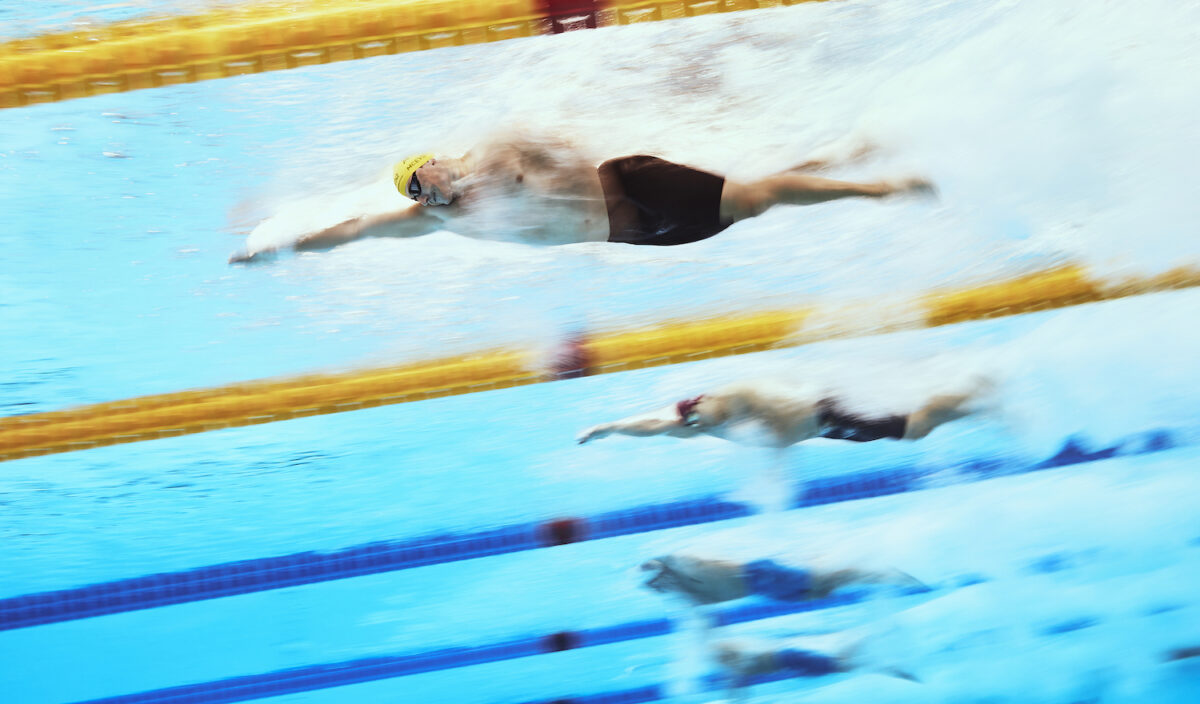
One session he did before breaking the world record is his Monday morning swim, done fresh after Sunday’s rest. The warm-up itself is structured like a gym lift pyramid: 200 metres of easy swimming, then a series of block dives at progressively increasing effort, building to 100% effort just like a weightlifter would build from bar-only sets to a working weight.
The session itself centres on a piece of equipment called the 1080 Sprint, a motorised resistance and assistance machine borrowed from track and field. He begins with four assisted 25-metre swims, with the machine pulling him at 2.4 metres per second, which is his race speed through the 15-to-25-metre section of a 50-metre freestyle.
Then, it’s three resisted 20-metre swims with fins and 3 kilograms of drag, with timing focused on the 10-to-15-metre segment, which replicates the 25-to-35-metre window in a real race. Next, it’s two 10-metre efforts with 4 kilograms of resistance and no fins, timed over 5 to 10 metres, to reveal any inefficiency in his technique. Finally, a single 10-metre effort with 11 kilograms of drag.
Between every rep, he allows himself ten or so minutes of rest, most of which is spent reviewing the previous effort’s data. This includes a timing system on the starting block that measures takeoff velocity, horizontal force output, and watts per kilogram produced by each foot, 5-metre split times, and a side-on camera running at 0.01-seconds per frame.
“I’ll get up, I’ll do my rep, and I’ll get immediate feedback on 20-plus pieces of data,” he says. He reviews it all, and before doing the next effort, hops in a hot tub to stay warm.
The nervous system, not the aerobic engine, is the core of McEvoy’s new theory of swimming. His understanding of what happens at the 35-metre mark of a 50-metre freestyle race is worth quoting at length, because it’s unlike anything conventional swimming coaching has produced:
“At the 35-metre mark – which corresponds to about 15 seconds of maximum output – your nervous system and your unconscious psychology start to reorganise what’s important from a survival point of view,” Cameron McEvoy reveals.
“Initially, at the start, you can hold your technical coordination and your power output to a pretty high standard, because there’s nothing really vying for that attention. But then, as you go through the race and you hit that 35-metre mark, you start to get signals about oxygen deprivation and by-product build-up (like lactic acid) coming through.”
“At that point, you have multiple signals that could be interpreted unconsciously as an attack on your survival, so what happens is your system gives your technical coordination a lower priority, meaning you start to lose the timing of your kick and your pull, the strength output at the right time, when to relax, and when to contract your muscles. In a medium like water, that slight change in technique is exacerbated.”
McEvoy’s solution is what he’s calling speed reserve. By training to maximise his peak starting velocity and holding back a fraction on race day, he gives himself enough of a buffer so that when the nervous system reorganises at 35 metres, the drop in technique doesn’t erase his lead. “If you start at 98% of your starting velocity, you can hold or maintain that speed for a much longer time than someone who has to start at 100%.”
Cameron McEvoy’s First Final
Over four Olympics and four trips to the starting blocks of the world’s biggest stage, Cameron McEvoy had never made an individual Olympic swimming final. In Paris, he stood behind the blocks of the 50-metre freestyle final and, remarkably, he wasn’t nervous. He had spent two years plotting every training rep along a bell curve, and he knew not just what he was capable of, but what his average was.
“If I had plotted out all of my reps that I’d done over the last two years along a bell curve, then if you take the average of that right in the middle, that gave me an extremely good shot if I were to replicate that in this final to win the gold medal,” he told the Olympics after the race.
“I dived in, I let the body do what it knew how to do. I just observed how it happened, and before I knew it, I was at the other end, and I’d won.”
Cameron McEvoy, Australian Olympic Swimmer
“I wasn’t behind the blocks trying to muster up this superhuman performance. I wasn’t trying to be in the 99th percentile of my bell curve of performance. All I had to be was my average, which not only gave me confidence, but it gave me a lot of reassurance to sit back and let the race speak for itself.”
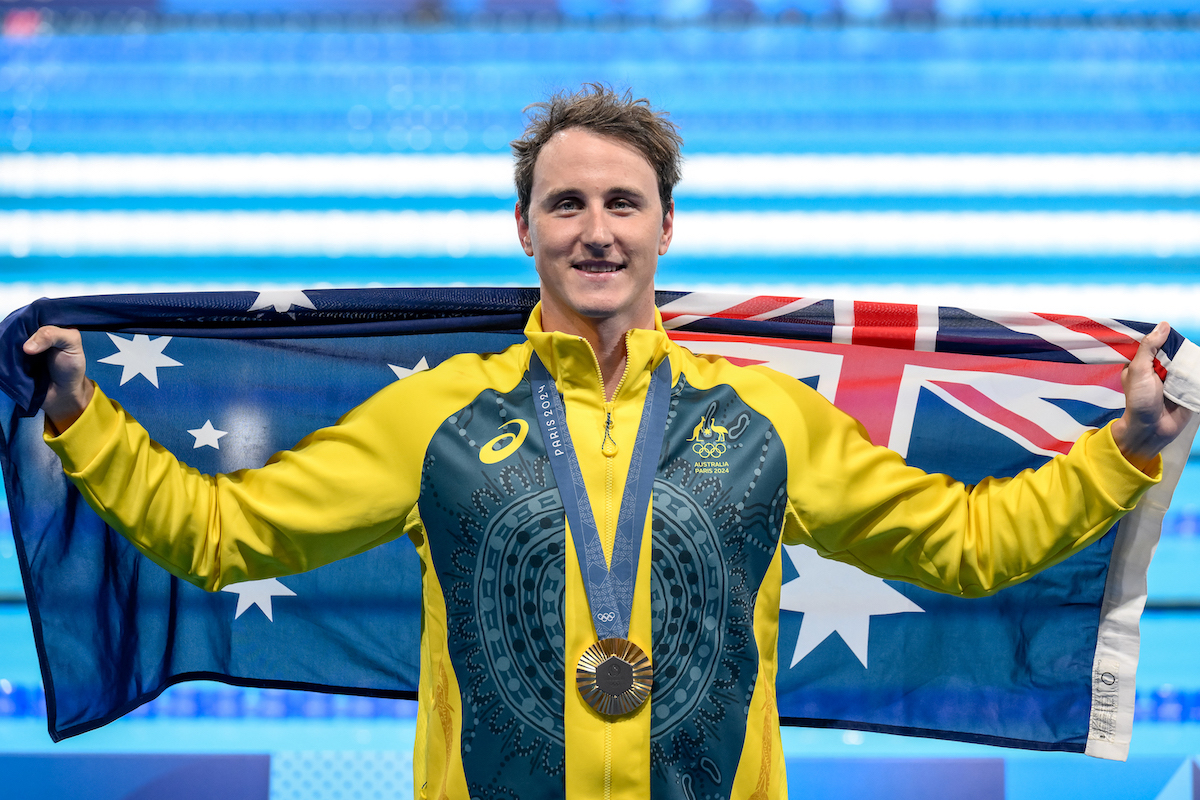
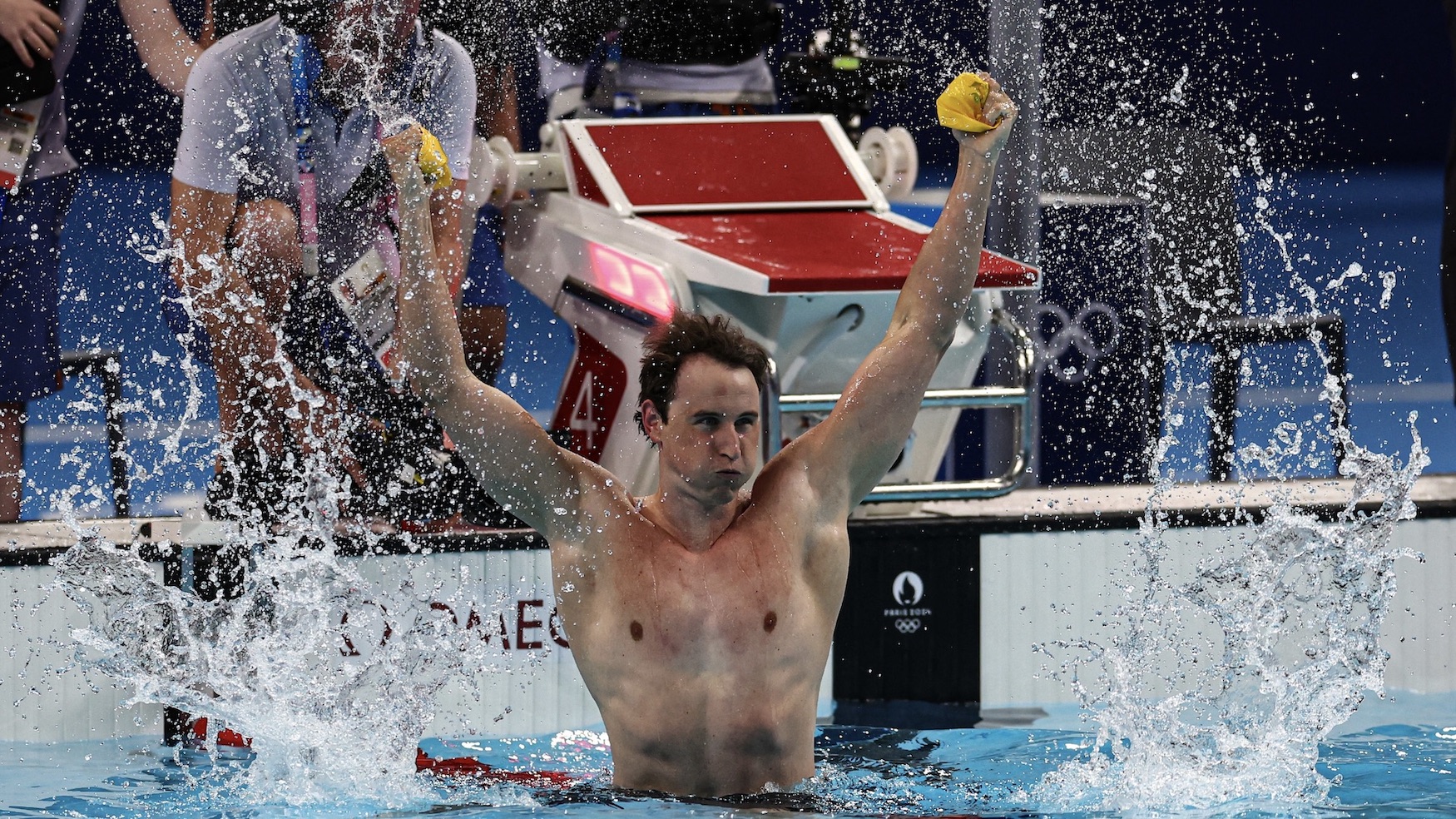
McEvoy touched in 21.25 seconds to secure the gold medal, making him the first Australian male to win an individual Olympic gold in the pool since Ian Thorpe.
It was a historic moment for the sport. For the first time in the history of Olympic swimming, not a single swimmer who competed in the 50-metre freestyle final also competed in the 100-metre freestyle final. Compare that to Sydney 2000, when Pieter van den Hoogenband won the 100 and 200 and took bronze in the 50.
The era of the generalist sprint freestyler, grinding through 30-kilometre training weeks to be competitive across three events, is ending, and McEvoy’s approach is part of why.
“My view for the future of swimming is the same thing that has already happened in track and field, which is that we’re converging towards more specialisation,” he says. “The type of training being laid down now for the 50 can be scaled up to the different events, and then from that scaling, you’re going to get your specialisation.”
The Old Guard
The Australian head coach, Rowan Taylor, is among the believers, Cameron McEvoy tells me.
“Right from day one, he was just like, ‘Look, I don’t know what you’re doing, but I’ll back you. Whatever you need, just let me know.’” Below that level, the reception has been less than enthusiastic.
“Generally speaking, below him, there’s been a lot of resistance,” McEvoy says. “That’s been pretty tough. I do understand that when something comes forward that challenges your beliefs, it’s human nature to want to shy away from it or defend yourself. But that doesn’t excuse the fact that there’s been a lack of professional curiosity around wanting to understand what is going on.”
The most common argument against McEvoy’s new approach is that his recent results are only possible because of his years of high-volume training that built the engine, and all he’s done is polish it. He finds this logic increasingly difficult to sustain.
“A lot of them are trying to justify it by saying I can only do what I do because I did their training for 10-plus years, and that it doesn’t work for other people. Which has been proven wrong time and time again by kids coming through who don’t have 15 years of base training under their belt, and they’re succeeding with this.”
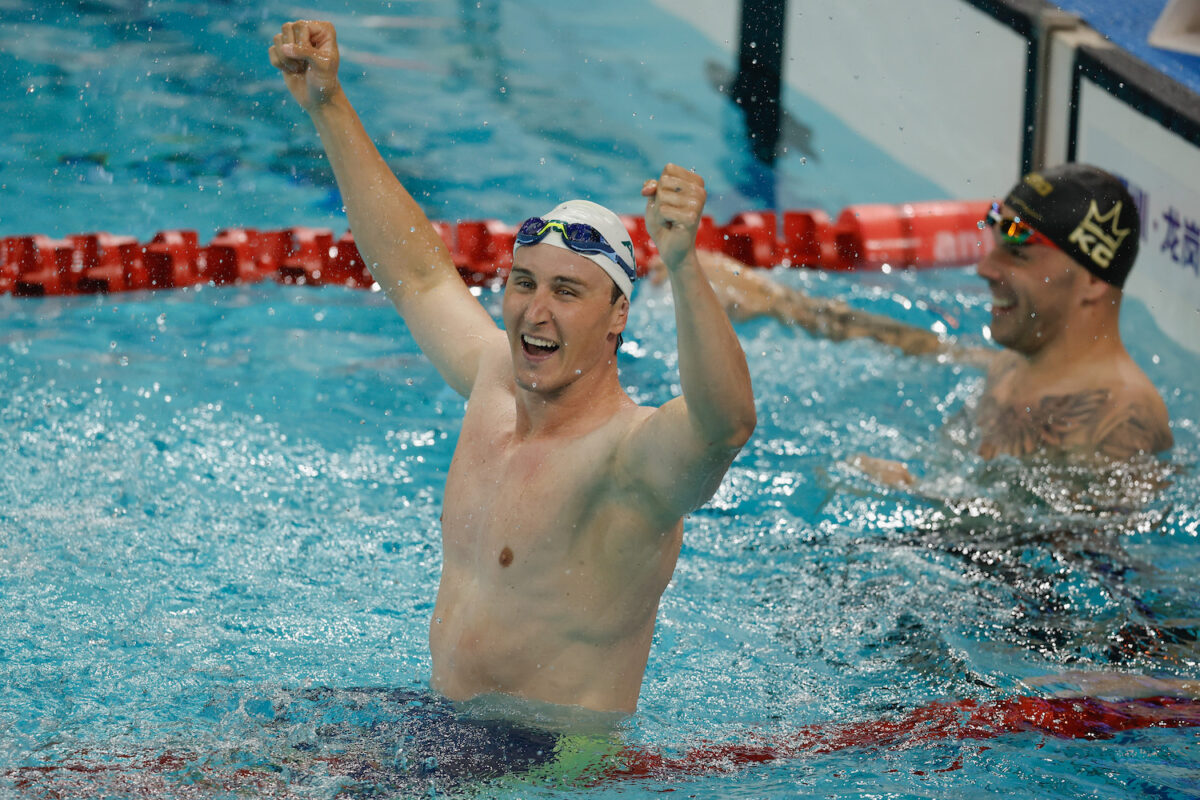
The most obvious example is Ollie Moclair, a now-18-year-old Australian swimmer who abandoned traditional training after the Paris Olympics in 2024. At 16, his personal best in the 50 freestyle was 23.9 seconds, but just 18 months later, training roughly five times per week for around one kilometre, he went 21.7 in the same event. It was the fastest time ever recorded by an Australian 18-year-old and would have been a world junior record if he’d been born three months later.
Overseas, pockets of similarly inclined athletes are appearing. At last year’s World Championships, by McEvoy’s count, roughly half the 50 freestyle final was training along similar principles. One veteran swimmer who had been a 21.9 performer his entire career made the change and went to 21.4 within a year, which would have earned an Olympic medal in Paris.
I asked if McEvoy was worried his openness about his training methods might be helping his competition.
“There are two games being played,” he tells me. “You have the game of winning a World Championship or doing your personal best time, and then you have this meta-game of influencing and improving the sport.”
“I get a lot of purpose out of the second one, and I really love sharing what I’ve learned. Whether that comes back and bites me in LA – it could – but I’ve also got to back myself either way. If I want to be the best in my races, I’ve got to be able to beat these people regardless of what training they’re doing.”
LA & Beyond
Commonwealth Games trials in Sydney in June 2026 are the next stop on the calendar, followed by the Games themselves in late July. Beyond that, Los Angeles 2028 is the end goal of this four-year cycle, and another Olympic event that will, for the first time, include the 50-metre butterfly and 50-metre backstroke alongside the freestyle. Two events Cameron McEvoy has already begun exploring with his methods.
Aged just 31, Brisbane 2032 remains in view, too. Anthony Ervin won the 50 freestyle at Rio aged 35, and Nicolás Santos won a butterfly world championship at 42.
For this Australian gold medallist, the 50-metre races are, by his own assessment, a strength-based skill event. For athletes who train it correctly, strength, unlike aerobic capacity, does not necessarily decline in the early-to-mid 30s.
“I definitely think I can get faster,” McEvoy says. On current evidence, there is no obvious reason to doubt him.