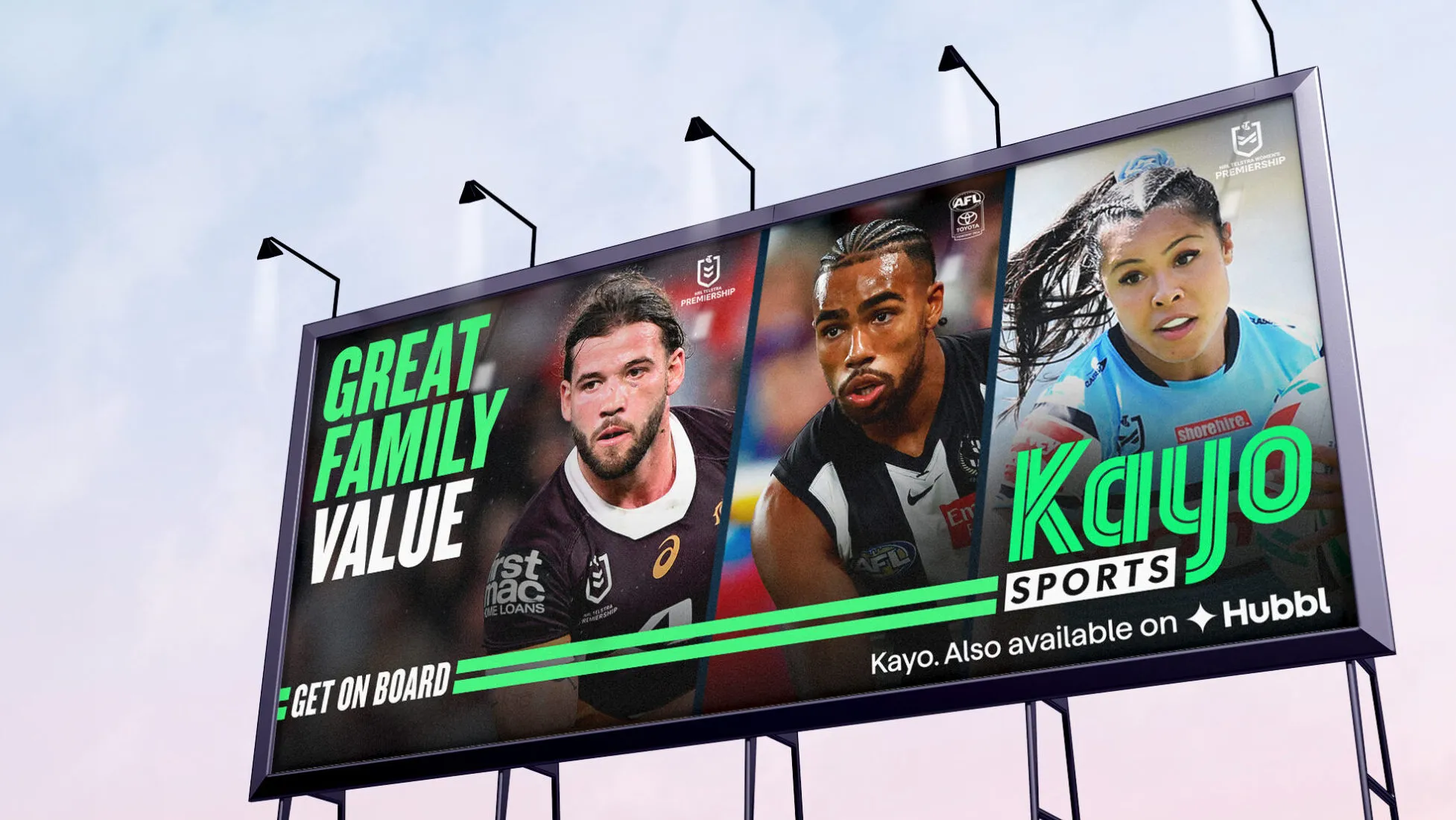

In February, Kayo raised its premium tier from $40 to $45.99 a month. That followed a jump from $35 to $40 less than a year earlier. If you’re keeping score – and someone certainly is – that’s a 31 per cent increase in under twelve months, on a product that launched at $25 in 2018.
The company explained, with a straight face, that this reflected “the cost of sports rights in Australia and internationally, and our continued investment in production and commentary, and cutting-edge technology.”
Realistically, however, this reflects a $3.4 billion acquisition that’s gone sideways.
In November 2024, DAZN – a London-based sports streaming company backed by Len Blavatnik’s Access Industries – acquired Foxtel for that sum. It was a deal that came pre-loaded with obligations: a $4.5 billion AFL broadcast contract and a $1.5 billion cricket deal, both shared with Seven, both already signed.
DAZN also inherited Binge, Foxtel’s entertainment streaming arm, which at the time of the sale still had HBO’s catalogue and a reason to exist. Then HBO Max launched in Australia in March 2025 and took it all back – Game of Thrones, Succession, the lot. Out of something between desperation and panic, Binge began offering returning subscribers half-price deals for twelve months. Which said everything, really.
Foxtel CEO Patrick Delany had argued, not unreasonably, that the business rested on two pillars: entertainment, which interests roughly the whole population, and sport, which interests maybe sixty per cent of it. Together, Binge and Kayo justified the eye-watering acquisition price.
But with Binge hollowed out, that justification has quietly collapsed – and what remains of it is the bit that charges you $45.99 a month to watch the footy.
Kayo and its roughly 1.5 million subscribers now have to carry the weight of a purchase that was built for two legs and is standing on one.
Former News’ Sport Network Managing Director, Michael Wilkins, put it as plainly as anyone in the industry will. DAZN, he said, are “more focused on price, yield and performance. They want to maximise what is working.“
What is working is you. Your direct debit. Your willingness to absorb another few dollars a month because the alternative is not watching live sport. That, in the end, is the product DAZN actually acquired. Not the content. The captive audience.
The problem is that captive audiences are only captive up to a point. The standard Kayo tier still sits at $29.99, but premium will cost you $551 a year. The diehards – those watching multiple games across multiple codes, every weekend, every season – can probably stomach that. They have already done the calculation and decided it’s worth it, and they’re probably right.
The casual fan is a different matter. The one who signs up for the Supercars season and cancels after Bathurst. The one who watches 24 Grands Prix a year and is now paying roughly $22 a race for the privilege. At some point the maths stops making sense, and when it does, these people don’t write complaint letters or post angry threads. They just leave and find other less legal ways to tune in.
This is where the strategy starts to eat itself. The value of a sports broadcast rights deal is not fixed – it is a function of audience size, and audience size is a function of price. Every casual fan priced off the platform is a viewer who isn’t watching, which is a pair of eyes a sponsor isn’t reaching, which is leverage the AFL or Cricket Australia doesn’t have the next time they sit down to negotiate. The very contracts DAZN acquired to justify the purchase price could, if the audience erodes enough, be worth considerably less when they come up for renewal. There is a particular kind of corporate irony in spending $3.4 billion on an asset and then managing it in a way that diminishes its value.
RELATED: Apple Moves To Overtake ESPN As Formula 1 Broadcaster In US; Opens Door For Global Streaming Rights
For the sports themselves – and the athletes, the sponsors, the whole ecosystem that depends on people actually watching – that is not an abstract concern. Broadcast rights revenue is the financial bedrock of Australian sport. Sponsorship money follows audiences, and audiences follow access. Nobody at the AFL or Cricket Australia will say this out loud while the current deals are running. But they are watching the subscriber numbers. Everyone is.
Sport in this country has never just been sport. It’s the thing that stops the nation for a horse race, empties offices on Grand Final Friday, and puts a footy in a four-year-old’s hands at Auskick before they can tie their own boots. It’s the common language across a massive continent that otherwise argues about everything – the shared vocabulary between a grandfather in Geelong and a grandson in Perth, and the fuel for water cooler small talk on a Monday.
But that ecosystem is built on the average punter and their kids tuning in. When the price of that Saturday ritual creeps north of five hundred dollars a year, and a household is quietly choosing between a Kayo subscription and a new school uniform, the subscription loses. It has to. What DAZN may not have priced into its spreadsheets is that the next generation of everyday rusted-on fans isn’t born in a stadium – they’re made on a couch, next to a parent, watching something they’ll one day pay to keep watching themselves. The audience you’re pricing out today is, by extension, the same one you’re dismantling for tomorrow.
Kayo launched in 2018 with the pitch of being sport for everyone – Foxtel without the bloat, at a price that made sense. Eight years later, it costs $45.99 a month, the increases have outpaced inflation by a comfortable margin, and the money is not going toward the sport. It’s going toward ensuring that someone in London doesn’t regret what they paid for Foxtel.
Whether enough subscribers stick around long enough to make that work is, for now, the only question that matters.