

This story originally appeared in Volume 6 of B.H. Magazine, pre-order your copy of Volume 7 now.
If a trip to Japan is on the horizon, there’s a good chance the idea of picking up a Japanese knife or two has already crossed your mind. Among the best places to shop for one is Tokyo’s Kappabashi Street – a famed kitchenware district lined with more than 160 specialty stores.
But for the uninitiated, navigating the world of Japanese knives can quickly become overwhelming. Between the different blade shapes, steel types, and handle styles, choosing the right knife requires more than just a passing glance. This guide aims to simplify the process.
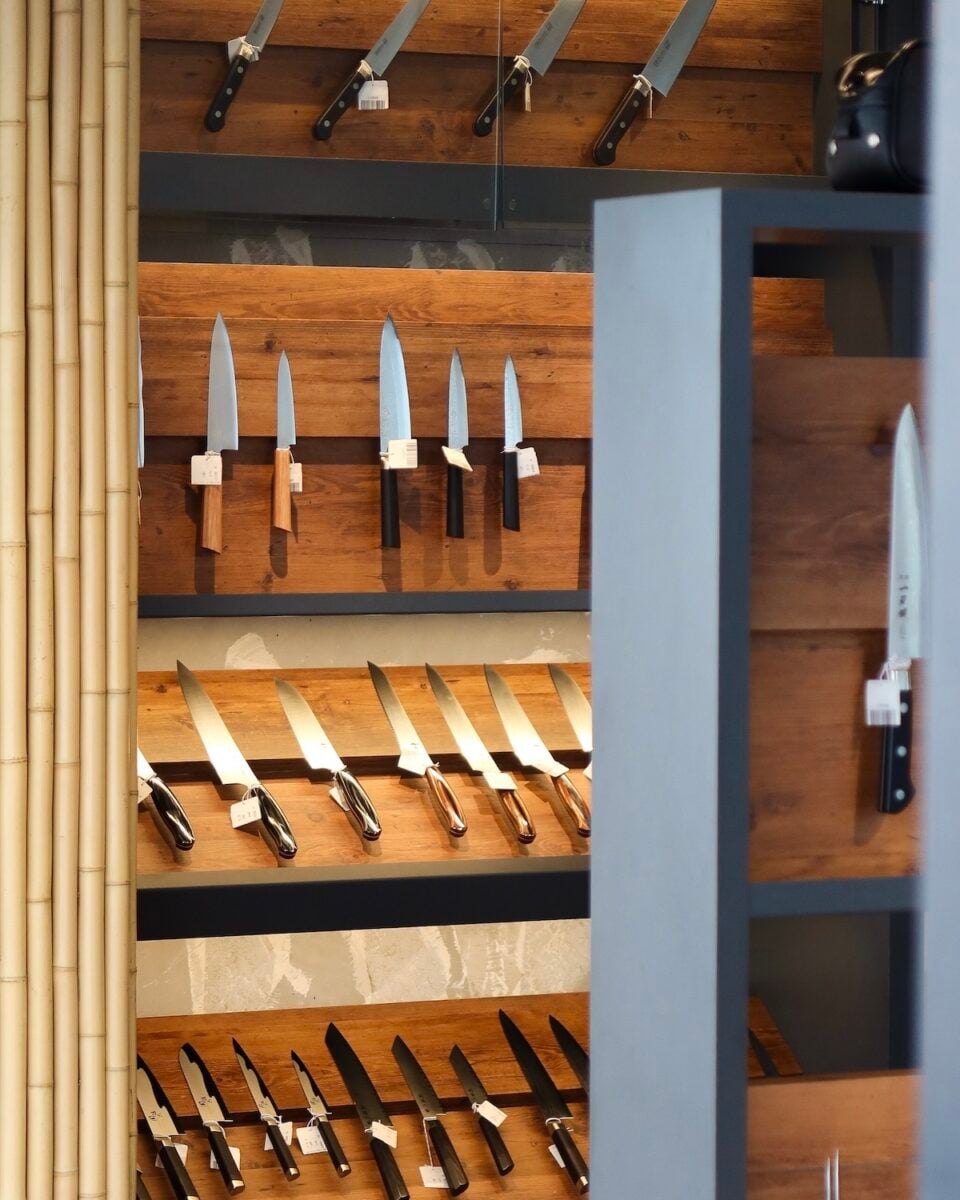
The Shape
For home cooks who aren’t breaking down whole tuna on a regular basis (most of us), there are two Japanese knives widely considered ideal for everyday use: the gyuto and the santoku.
The gyuto, Japan’s take on the Western chef’s knife, emerged in the late 1800s after French and German blades were introduced to the country. Japanese makers adopted the multi- purpose design, and refined it in their own style, creating a knife suited to a wide range of kitchen tasks.
The santoku, on the other hand, has more traditional Japanese roots. Evolved from the nakiri – a vegetable knife – the santoku was developed to be more versatile. Its name means “three uses”, referring to its ability to handle meat, fish, and vegetables.
If you’re after one knife that can do nearly everything, either will serve you well. The differences between them are subtle: the gyuto usually has a longer blade, a more pronounced curve along the edge, and a sharper tip – traits that offer more control for rock-chopping or precision slicing.
For those who already own a solid all-rounder, two other knives worth considering are the kiritsuke and the petty knife.
The kiritsuke is essentially a more specialised gyuto – thinner, with a flatter profile, and an angled tip – making it ideal for fine, intricate cuts. The petty, meanwhile, is a compact utility knife designed for jobs where a larger blade feels unwieldy: think trimming vegetables, slicing fruit, or tackling small boning tasks.
In truth, if your kit includes a gyuto and a petty knife, you’re covered for almost any home cooking task you’re likely to face.
The Steel
Once you’ve settled on the type of knife you want – and the budget you’re working with – the next major decision is the steel. It’s what determines the blade’s sharpness, edge retention, maintenance requirements, and overall feel. While there are countless variations, Japanese knives typically fall into one of three steel categories: carbon steel, stainless steel, and powder steel.
Carbon Steel
Favoured by traditionalists and purists, carbon steel is prized for its hardness and ability to take on an incredibly sharp edge. Two of the most well-known carbon steels used in Japanese knives are shirogami (white steel) and aogami (blue steel). White steel is known for its purity and ease of sharpening, ideal for achieving razor-sharp precision. Blue steel has a slightly more complex alloy that improves edge retention and durability.
Though, that sharpness comes at a cost. Carbon steel blades are more prone to chipping and will oxidise if not cleaned and dried properly after each use. Over time, they’ll develop a natural patina – or, if neglected, rust.
Stainless Steel
Powder Steel
For those chasing the best of both worlds – and willing to pay for it – powder steel is the pinnacle. Forged using a high-tech metallurgy process, it combines the edge-holding power of carbon with the rust-resistance of stainless.
Popular powder steels like ZDP-189, Super Gold 2 (R2), and HAP40 offer exceptional hardness and performance. These blades stay sharper for longer, resist wear and rust, and feel every bit as premium as their price tag suggests. Forging powder steel is complex and costly, which means the knives don’t come cheaply. But if you’re after a blade that could last a lifetime, this is where to look.
The Handles: Japanese vs Western
When it comes to Japanese knives, the blade may get all the attention, but the handle plays a big role in how the knife feels and performs. Japanese handles are traditionally crafted from natural materials like wood or bone, and are known for being lightweight and delicately balanced.
The partial tang construction – where the blade only extends partway into the handle – reduces weight and shifts the balance point forward for more precise cutting. The trade-off? These handles are generally less durable and more susceptible to moisture damage over time. But they’re also easier to replace, and many prefer the refined, organic feel they bring to the knife.
By contrast, Western-style handles are built for durability. Typically full tang, with riveted scales, they offer a heavier grip and greater strength for tough chopping tasks. While harder to repair, Western handles require less maintenance overall and tend to hold up well under daily use.
Knife Care Essentials
Owning a well-made Japanese knife is one thing – keeping it in top condition is another. These blades are designed for precision, but they demand a little respect in return.
Rule number one: never put your Japanese knife in the dishwasher. The combination of heat, water pressure, and detergents can dull the blade and damage the handle – fast. Instead, wash the knife by hand with a soft sponge or damp cloth immediately after use. Avoid abrasive scourers, and always dry the blade thoroughly before storing it. This is especially important for carbon steel, which is prone to rust if left damp – but even stainless steel will benefit from proper care.
To preserve the edge, the ideal cutting surface is a wooden board. Plastic boards are serviceable, but they can cause micro-chips if the blade twists or digs in. Hard surfaces like glass, stone, or ceramic are a definite no.
Japanese knives are engineered for precision, not brute force. Avoid using them on bones, frozen foods, or hard-skinned stone fruits. Not only can this damage the edge, but it also increases the risk of chipping – even with the toughest steels. Treat your knife well, and it’ll stay razor-sharp for years. Neglect it, and you’ll be left with something closer to a letter opener.

The Art Of Sharpening
Sharpening a Japanese knife properly is a skill in itself – and while it could fill an article of its own, the basics are easy enough to learn with a little practice.
Start with a whetstone, ideally a 1000-grit stone for general maintenance. For polishing the edge to a finer finish, consider adding a higher-grit stone to your setup (3000–6000 is ideal for home use). Before sharpening, soak the whetstone in water for 20–30 minutes. Keep the surface wet as you work, and if you’re new to the technique, practice on a regular kitchen knife to get a feel for the correct angle – usually between 10–15 degrees for Japanese blades.
There are plenty of excellent tutorials online, and watching a few before you begin is a smart move. It can feel intimidating at first, but once you get into the rhythm, sharpening becomes part of the ritual and part of the reward.
A Note About Storage
The quickest way to dull a high-quality blade? Let it rattle around in a cutlery drawer. Your best bet is to store the knife in its original box, or invest in a wooden saya (sheath) or a leather blade guard. These will protect the edge and keep the knife safely separated from other utensils. For carbon steel knives, an occasional wipe with a few drops of camellia oil will help prevent oxidation and extend the life of the blade. A little maintenance goes a long way – especially with something this finely made.