

Editor’s Note: This story originally appeared in Volume 6 of B.H. Magazine, pre-order your copy of Volume 7 now.
(Photos James Want)
It's not until the final stretch that the desert really begins to swallow you. The last hour of the four-hour journey south from Delhi winds through lively villages, where streets are lined with contented cows, open-air shops, and barefoot children who wave as we pass by. The road gets bumpier, the air thicker, and the mountains closer.
Then, without fanfare, Amanbagh appears – like a mirage summoned by the god of architecture. Pale-pink sandstone walls rise from a grove of eucalyptus and palms, as if Mughal emperors ruled here and the party never ended.
Once through the guarded gates, the outside world vanishes. The dust and horns and chaos of India – the wild tangle of life that spills onto every road – disappear behind high walls and manicured palms. Inside the property, there’s quiet. Not the eerie kind, but the kind money rarely buys.
At the hotel’s grand entrance, we’re welcomed with prayers and blessings that echo through the almost-holy space. A garland of marigolds, a chilled towel, and a glass of fragrant cardamom water dissolve the distance we’ve travelled. There’s no check-in desk, no small talk. Just the sense that you’ve slipped into a peaceful dimension.
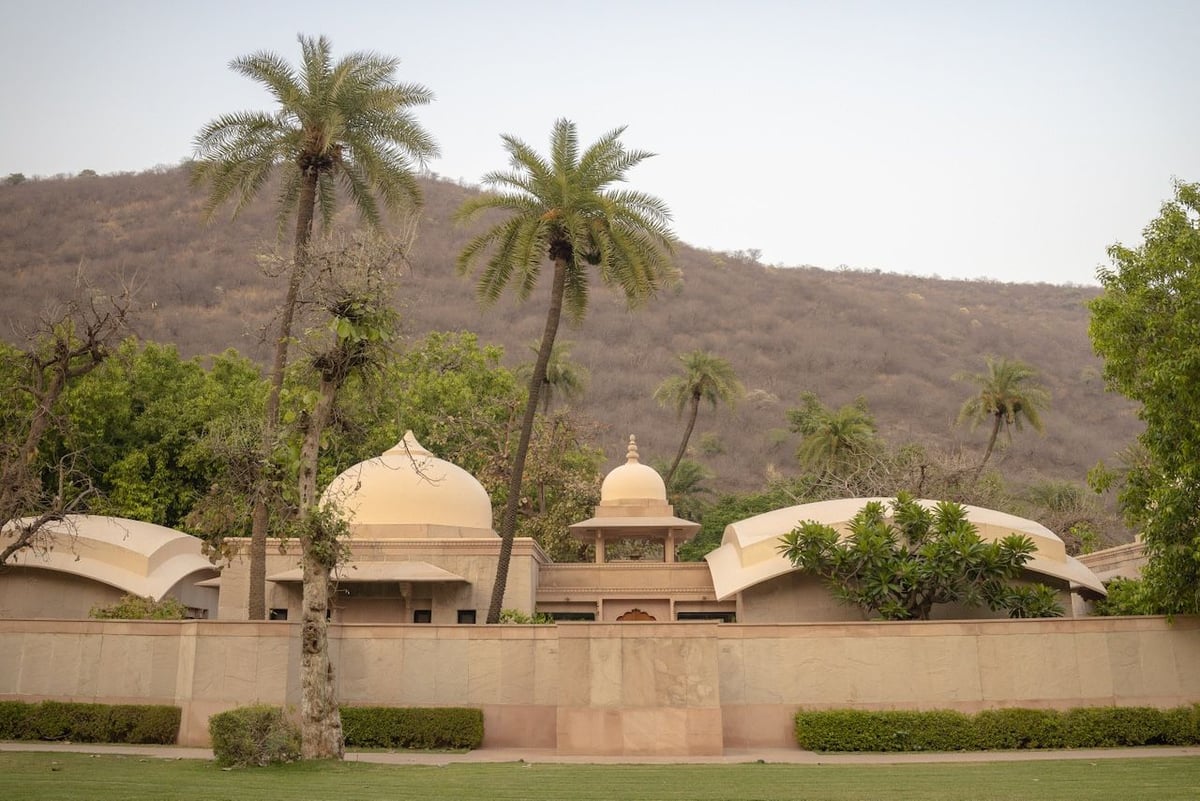
Originally built as a royal hunting lodge for the Maharajah of Alwar, Amanbagh has been reimagined in a way only Aman could pull off. Palatial yet minimalist, with scalloped arches, domes, and colonnades creating a quiet grandeur.
As we’re guided to our room, the golden afternoon light spills across the courtyard, while jali screens cast delicate lacework shadows. In this moment, we begin to understand that silence is luxury. Exhale…
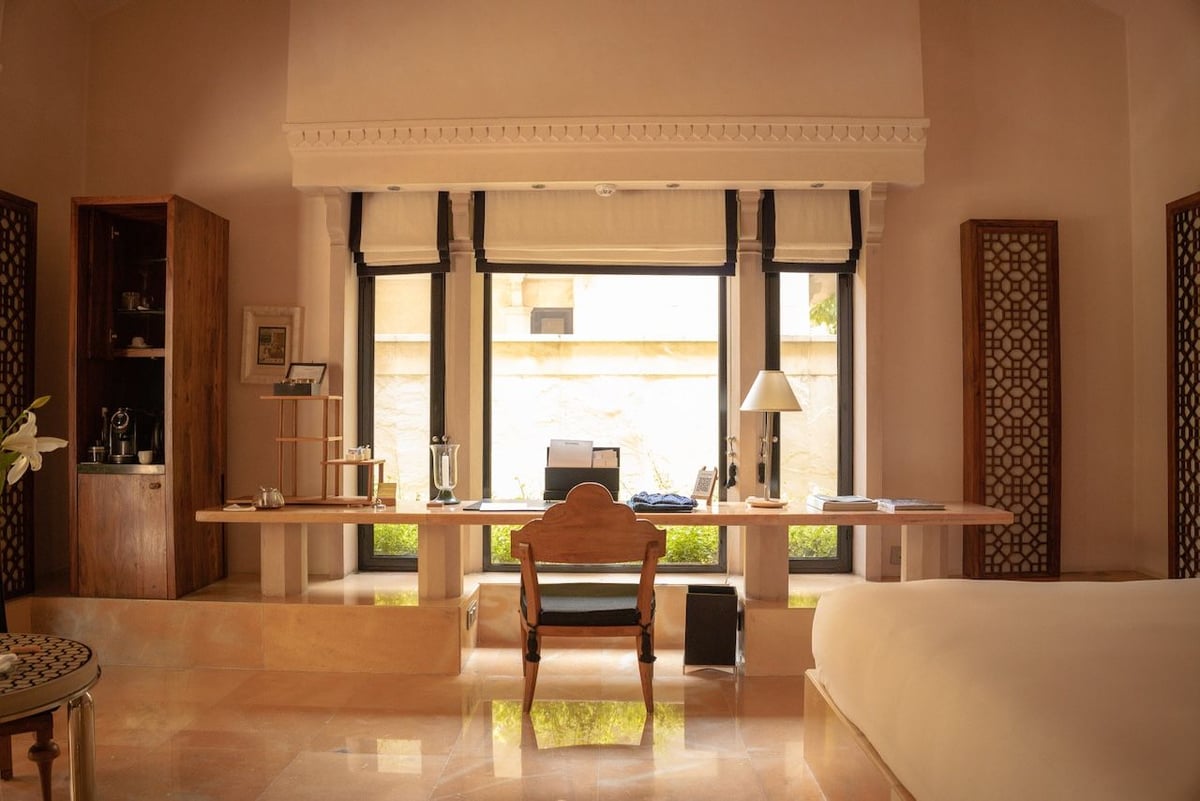
The garden is expertly trimmed and tended to by impeccably dressed gardeners, to whom we offer polite nods before arriving at our Pool Pavilion. Palatial is the only word that comes to mind as the door swings open.
Divided into three parts – an entrance hall, bathroom, and bedroom – the 203-square metre villa is almost too big. The domed ceiling rises like a cathedral above the bed, and the Udaipur green-marble bath is deep enough to swim in. There’s no art, no television – only space and serenity.
One of the first things we’re shown is the monkey stick. Propped just inside the front door, it’s a gentle reminder that we’re not the only ones with a key to the place. Each room opens out to a private walled garden, where a family of monkeys – including tiny babies – drops by uninvited almost daily to inspect the plunge pool and play in the low-hanging branches before chasing each other over the wall. They’re pure entertainment and, thankfully, we never need the stick.
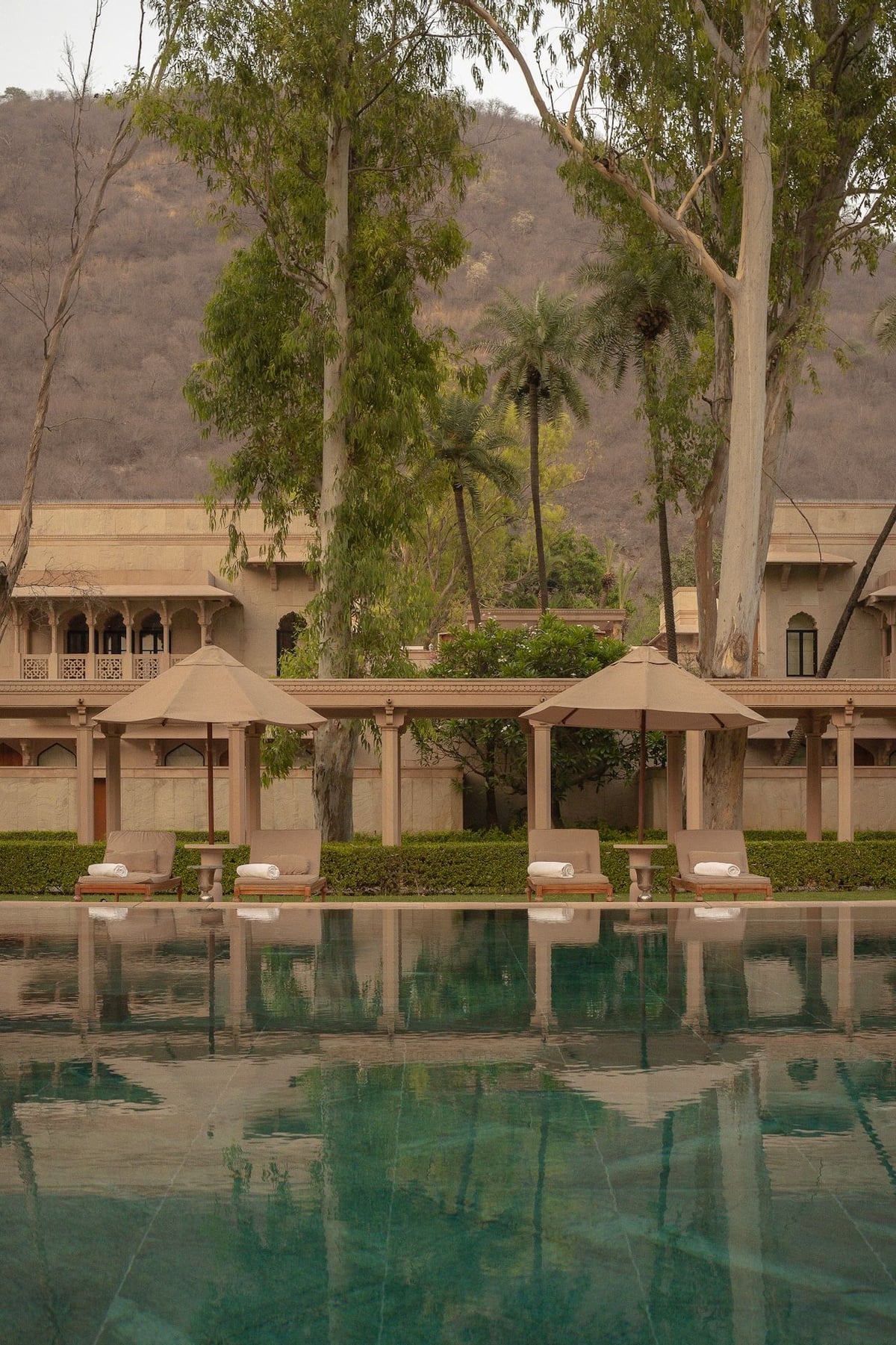
Despite the monkeying around, you don’t come to Amanbagh for a scene – there isn’t one. You come to disappear. To float aimlessly in the 33-metre pool while rose-ringed parakeets commute overhead. To read under a neem tree until your eyelids droop. To order room service two days in a row because the kathi roll – an Indian wrap with spiced chicken – is best eaten while enrobed, in bed.
As the sun and temperature begin to drop, we meander to the front garden where two camels sit patiently, waiting to offer gentle joy rides. Their fur is trimmed into intricate patterns, and colourful netting drapes across their humps like festive armour. This elaborate grooming is more than simple decoration – it reflects the herder’s artistry and honours the camel’s deep cultural and economic significance in the region. We cut a few slow laps around the field and dismount in time for happy hour.
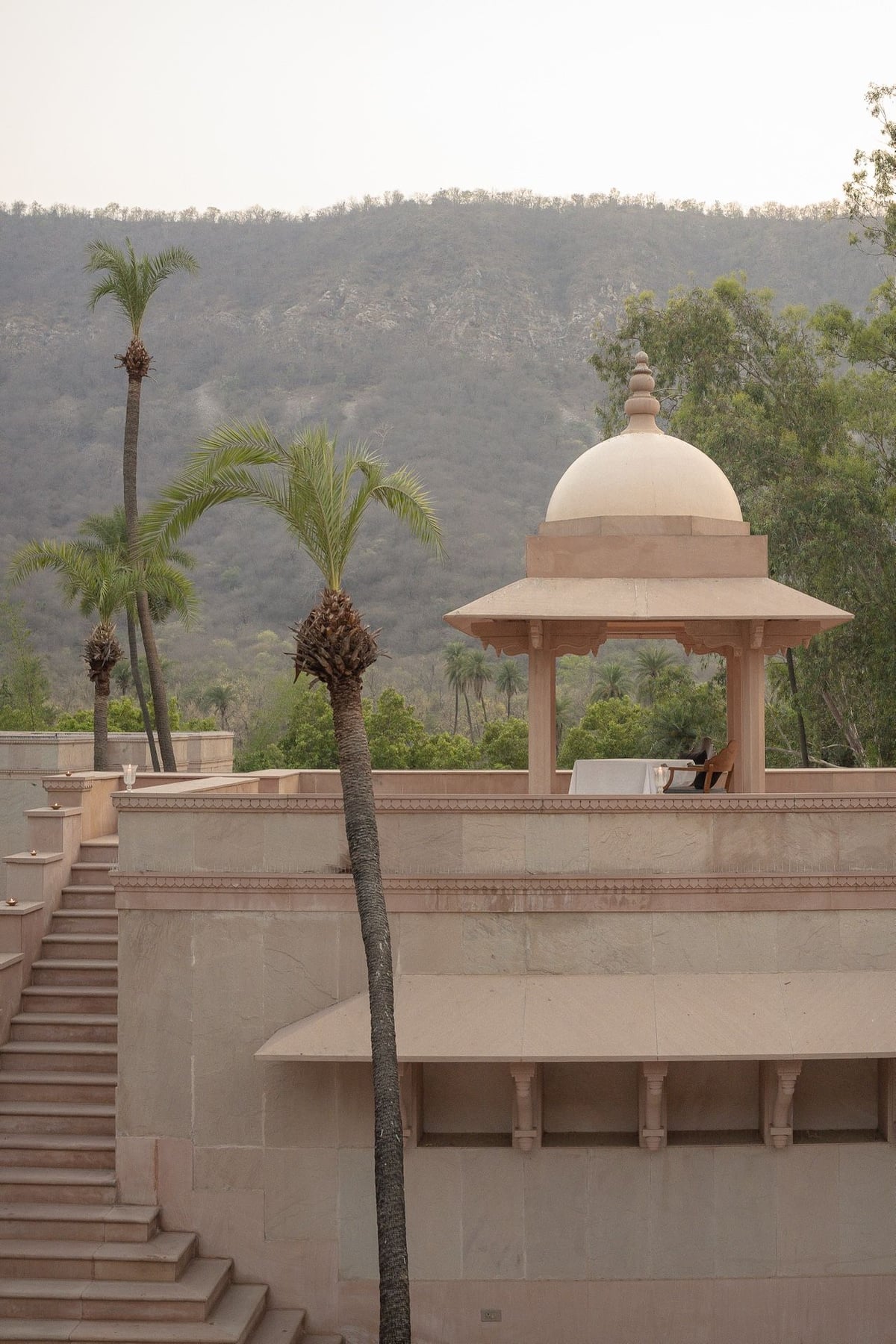
There’s really no better place to sip a well-executed margarita than on the towering rooftop overlooking the pool, snacking on crisp, spiced chickpeas as dozens of peacocks glide into the trees above to roost. According to the staff, each bird returns to the same branch at the same time every evening, like clockwork. I didn’t even know peacocks could fly until now.
At dusk, candles appear in brass holders and crickets hum beyond the hotel walls. Dinner can be served indoors or out, depending on your mood, and the weather. The one constant is the nightly serenade: a musical duo, one with tabla (hand drums), the other with a bansuri (bamboo flute), filling the air with tranquil sounds. The only trace of the outside world is an occasional and absurdly cheerful car horn echoing through the night.
The food is generally good, not extraordinary, with the Indian dishes standing out as the best choices. Of course, there’s thali – a traditional meal served on a round metal platter, featuring a variety of small dishes with a selection of breads. It’s a great way to sample regional specialties, as the offerings often vary by province. Our favourite dish is the lal maas, a rich, slow-cooked goat curry infused with bold Rajasthani spices and the distinctive heat of Mathania chillies.
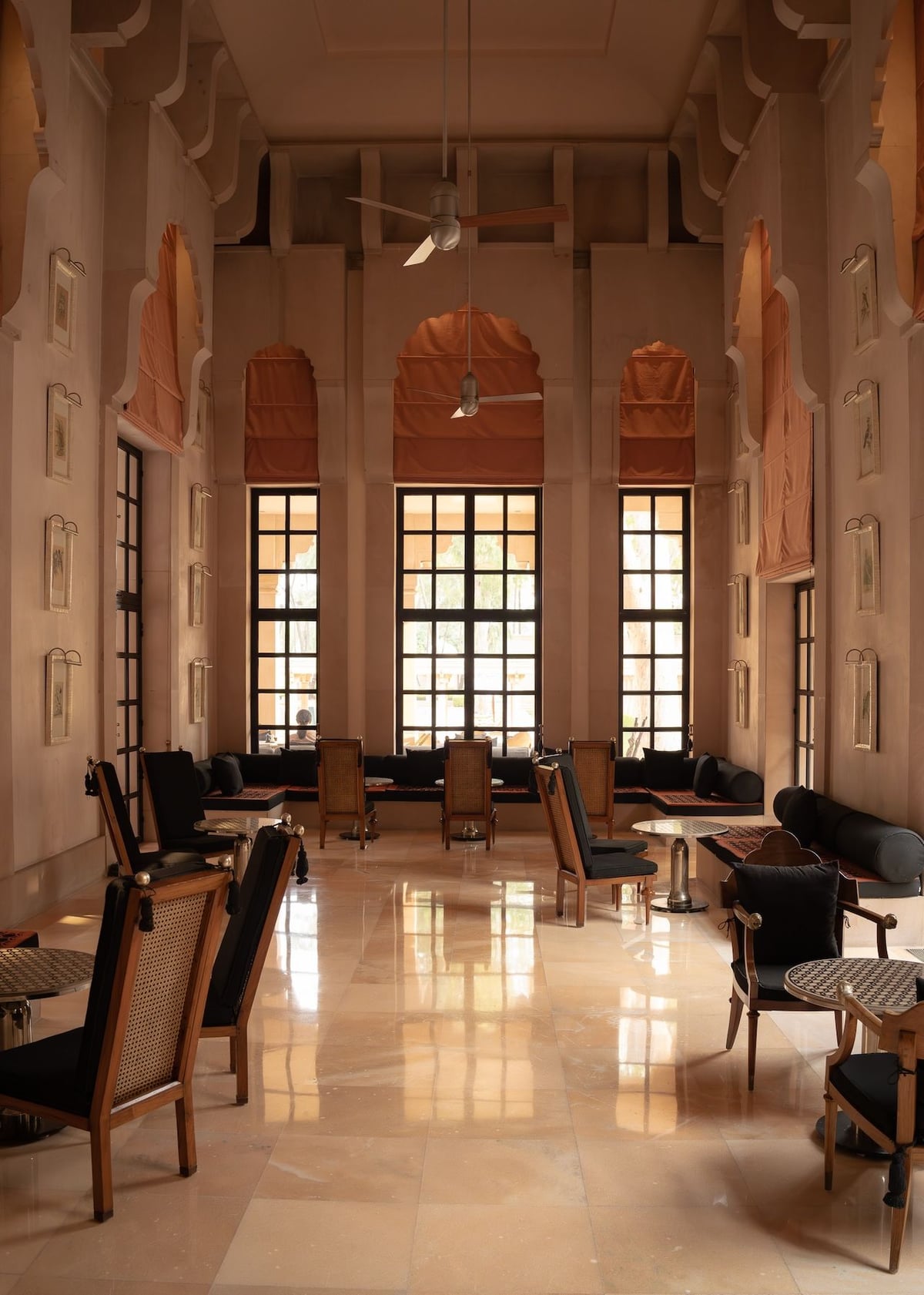
Some cocktails take inspiration from local flavours, which is a thoughtful touch, though the wine list leans more serviceable than inspired; a surprising detail in a place that gets so much else right. But somehow, none of that really matters.
After dinner, guests drift through the courtyard and back to their villas – there’s a hedge-fund founder and his girlfriend, a mother and daughter celebrating something special, and a young couple on their honeymoon. It’s quieter than usual. Many travellers avoid Rajasthan in the searing heat of summer as temps can soar above 40 degrees, but those who do come are rewarded with a rarer kind of luxury: a near-empty hotel.
The service here deserves its own chapter. It’s generous to a fault – gracious, eager, and deeply sincere – but also unrelenting. The desire to please borders on anxious, every smile weighted with an almost urgent need for approval – the exact opposite to Aman Kyoto. It’s not unique to Amanbagh; it’s India. A country so alive with contradictions that even its hospitality brims with intensity.
Despite this, days fall into a gentle rhythm. We start with yoga by the pool, followed by potato-stuffed dosa – a thin, golden rice crêpe – and fresh fruit drizzled with sweet lime juice, enjoyed in the garden. For those craving adventure, there are excursions – tiger safaris through Sariska National Park or visits to the haunted 17th-century ruins of Bhangarh Fort – but each comes with a serious price tag. It’s the Aman way. Experiences are immaculate, but they’re never cheap.
Venture beyond the resort’s gates and the contrast hits like heat on metal. India’s rawness is immediate and inescapable – confronting and beautiful in the same breath. Upon your return, you begin to see how carefully Amanbagh has choreographed its incomparable brand of calm. For us, the thrill of doing nothing is more than enough – especially with the energetic city of Jaipur awaiting us at the end of our stay, which is just a 90-minute drive away.
Amanbagh isn’t about spectacle. It’s about subtraction. When you strip away the noise, you begin to feel something close to total relaxation – that rare state where time slows and your mind follows. It’s a place where you can nap too long and stay in the pool until your skin shrivels, yet still feel as though you’re nourishing something deeper.